The Importance of a Workforce Capability Framework
Last Updated: February 2026

What it is, how to build one, and why it’s your organization’s best weapon are all included in this guide.
Employee development needs, well, some development. A traditional skills-based approach isn’t moving the needle anymore (if it ever was).
What organizations actually need is clarity on what good work looks like, how it shows up in practice, and how it connects to business outcomes. Enter: the capability framework. Enter: the capability framework.
A capability framework defines the skills, knowledge, behaviors, tools, and processes needed for employees to deliver outcomes the business depends on. Think: Role design, performance management, recruitment, and professional development. And most crucially, it’s what defines your ability to grow and succeed.
This guide covers what a workforce capability framework is, how to build one, how to apply it, and why it’s one of the most effective tools HR and L&D have for driving real impact.
TL;DR: What is a workforce capability framework?
A workforce capability framework outlines the skills, behaviors, knowledge, tools, and processes required for an organization to achieve its goals. Capabilities are mapped to job roles and job families to define what is important for an employee to be successful in their role.
Capability frameworks can be used to:
- Recruit external talent
- Develop performance
- Identify top performers
- Create internal mobility.
What is a capability (and how is it different from a competency or a skill)?
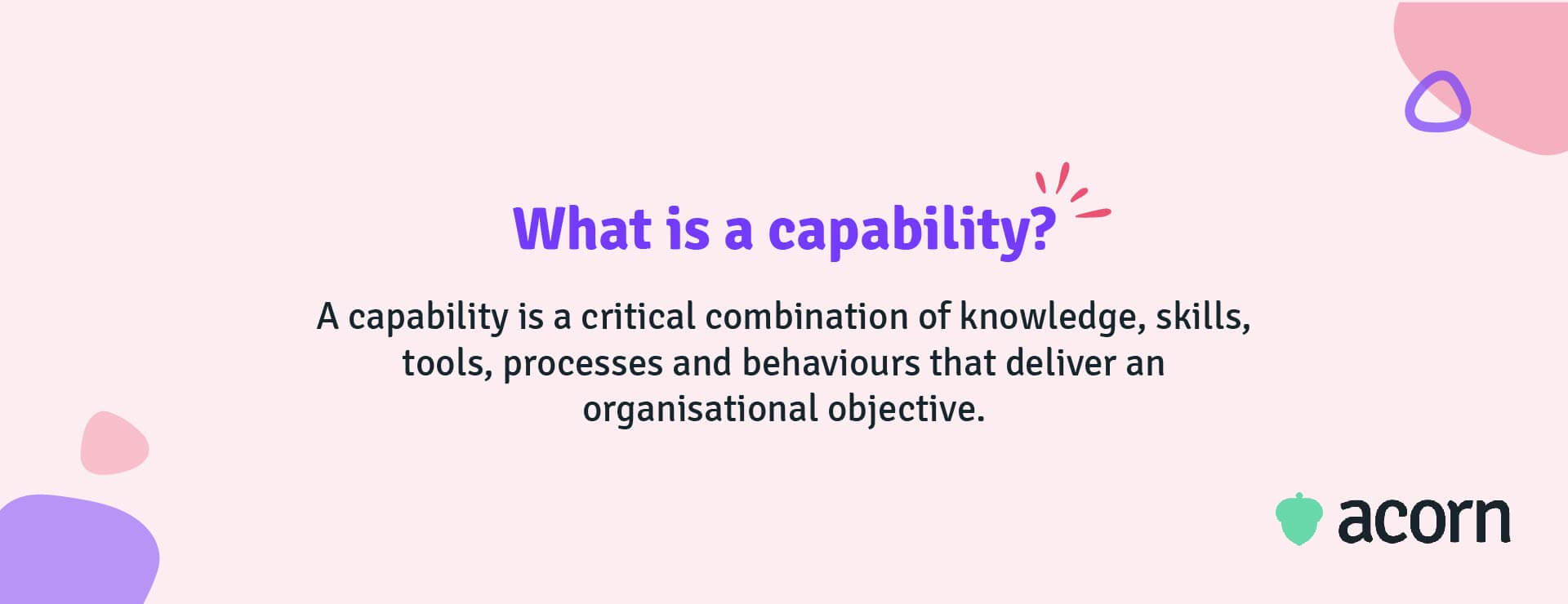
Skills are discrete abilities (for example, stakeholder communication or data analysis). Competencies typically describe proficiency in a specific area, often assessed at an individual level.
Capabilities are broader and outcome-focused. They combine the above with other factors of performance to enable it in context.
A skills matrix shows who can do what. A competency framework assesses how well someone performs a task. A capability framework explains how work gets done successfully across the organization.
These terms are often used interchangeably, but the differences matter when you’re designing frameworks that need to scale beyond a single team or role.
If you want to go deeper, we’ve unpacked the distinctions here:
- Capabilities vs skills
- Competency vs capability
- Skill vs capability vs competency
- Capability vs ability
Why are capability frameworks important to human resources?
Capabilities define what a business does in order to fulfil its mission.
A capability framework describes those capabilities and associated expectations of proficiency in a way that all employees can understand.
For HR teams, a workforce capability framework acts as a single source of truth, aligning recruitment, performance management, learning, and workforce planning around shared expectations of what good performance looks like.
For example, the NSW Public Sector Capability Framework lists Manage Self as a capability. Across increasing levels of proficiency, this includes:
- Prioritizing one’s task load
- Evaluating your own performance & seeking feedback
- Seeking development opportunities
- Managing emotions
- Taking initiative
- Utilising negative feedback for growth
- Acting as a role model for colleagues
- Promoting the value of self-improvement
- Keeping up to date with current practices.
Your capabilities will and should change as your company grows and your goals evolve. The roles required in a tech start-up will be more niche than those in a global software company. And the roles that tech start-up needs when they’re past their growth stage will be vastly different and more varied than the first time they ever recruit.
Then there’s the employee experience to consider. How do employees know whether they’re performing well? How do they understand what’s expected of them, or what they need to develop next? Can managers confidently and consistently assess performance across teams?
This is truly where capability frameworks matter.
By defining the skills, knowledge, and behaviors required for effective performance at all levels, you create a shared language that’s accessible across the organization. A capability framework also establishes how each role contributes to broader organizational outcomes.
This shared language is particularly important during periods of digital transformation or organizational change, when roles evolve faster than job descriptions, and HR needs to effectively align their work with strategic business goals, as well as more clearly communicate across departments.
The 12 key benefits of a capability framework
Implementing a capability framework enables your organisation to:
- Recruit talent more effectively through job and role design
- Maintain an adequate talent supply now and into the future
- Better evaluate performance and manage talent
- Identify and close capability gaps more efficiently
- Provide more personalised professional development—and prove their impact
- Improve the quality of services or products and customer or client relations
- Act on strategic succession and workforce plans
- See clear progression from level to level
- Enact change management processes
- Stay clear on how to successfully complete daily tasks
- Understand and unlock leadership potential
- Create career pathways across teams and departments.
Collectively, these benefits help HR move from administering programs to enabling measurable business performance. So, yeah, not exactly small change.
The structure of workforce capability frameworks
In practice, this structure usually shows up through a number of core components.
- Focus (or core) capabilities that reflect what the organization must do well to succeed.
- Role or function-specific capabilities that translate those priorities into job-relevant expectations.
- Proficiency or competency levels that describe how performance expectations increase with scope and responsibility (not just job level)
- Clear performance descriptions that show how capabilities are demonstrated in real work.
Where skills are often transferable across organizations, capabilities and capability frameworks are always contextually unique to your company. They take shape based on how your organization operates, the outcomes it needs to deliver, and the environment in which work happens.
They’re not tied to one team or process, either. Although a framework can resemble an organizational hierarchy, capabilities aren’t tied to individual teams or processes. They’re defined by what the business needs to do. If you would change a capability to “suit” different departments, or every time you implement a new system involved in delivering that capability, it’s not an organizational capability.
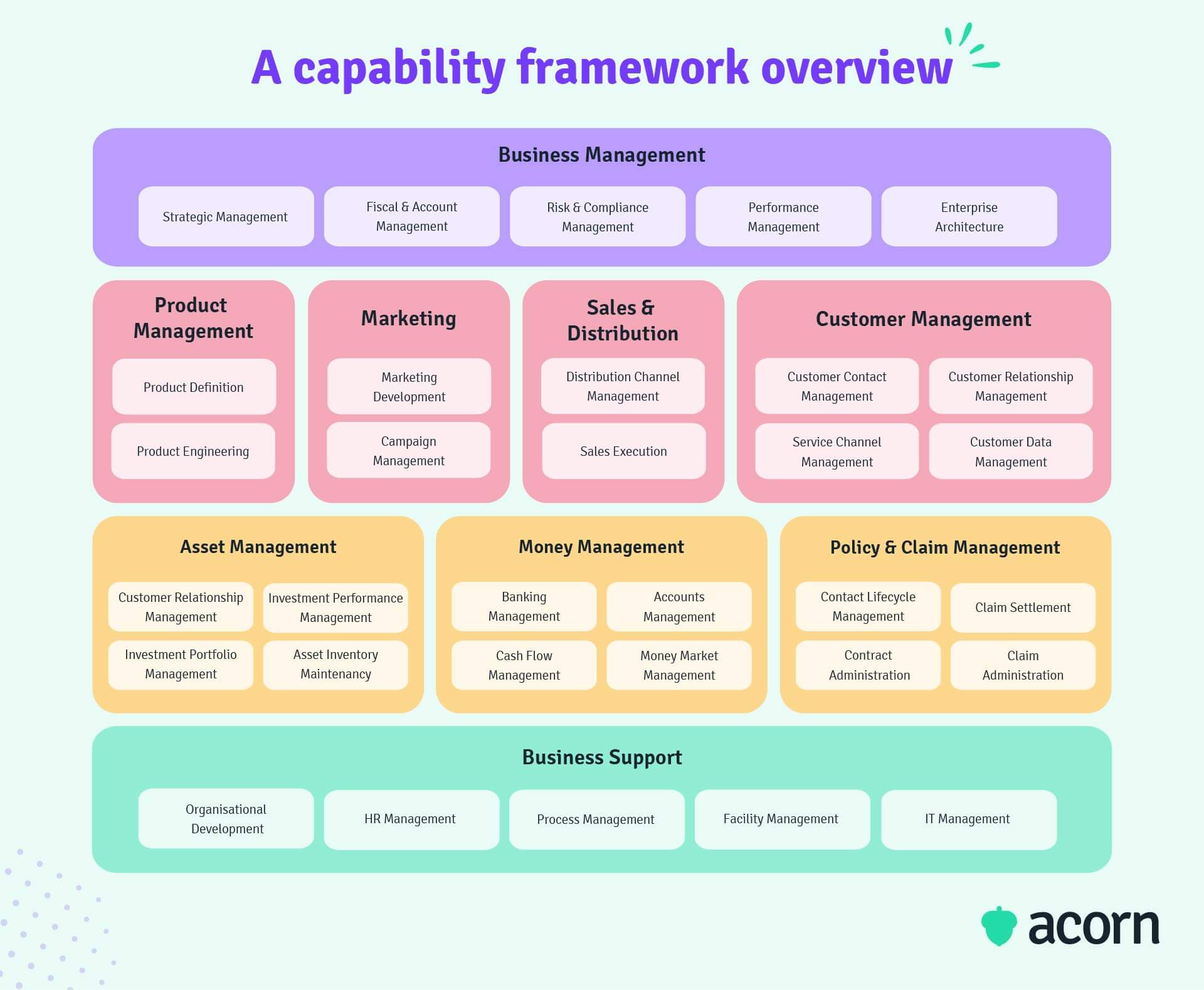
With that in mind, capability frameworks are usually organized for clarity, not ownership. They’re typically presented in groups or categories first, hierarchy second. At the highest level, this means a small set of focus capabilities that apply across the organization (read more below). From there, capabilities may be grouped by job role or function—such as marketing or sales—to make expectations easier to understand in context.
What are focus capabilities?
Focus (or core) capabilities are the main groupings of capabilities within a framework. These are the highest level of knowledge, skills, and behaviors that are essential to how the organization operates and succeeds.
They exist to provide structure. Rather than starting with roles or tasks, focus capabilities establish the main domains of success first, with more specialized and specific capabilities layered underneath. This keeps the framework oriented around outcomes, not org charts.
Examples of focus capabilities include:
- Operations
- People management
- Personal attributes
- Governance
- Strategy
- Leadership
- Relationships.
These are broad drivers of business success, and in practice, often encompass business values and goals. Unilever lists Product Management as a focus capability because it is core to business operations. This is part of what Unilever does. McDonald’s emphasizes Community, which aligns with their charitable contributions, like the Ronald McDonald House.
If you’re looking for concrete examples of how these focus areas are defined and structured, Acorn’s Capability Library provides a practical reference point, showing how capabilities can be grouped and described at this level.
How to apply a workforce capability framework
First and foremost: A capability framework only creates value if it’s actively used. Without one, learning and development becomes reactive rather than part of a deliberate workforce strategy.
Applied well, a capability framework acts as a decision-making tool. It helps organizations prioritize what to develop, where to invest, and how to measure progress. In practice, this shows up across three core areas:
- Aligning learning and business outcomes
- Supporting learning in the flow of work
- Evaluating learning effectiveness.
Align learning with business outcomes
A capability framework should link individual development directly to organizational objectives. That starts with clarity on what the business needs to deliver now and in the future, and which capabilities are required to support those goals.
L&D history shows that most corporate learning initiatives struggle to show impact. So, we start at impact. From there, gap analysis and assessments make it possible to identify where current capability falls short. This gives HR and L&D a clear basis for prioritizing development, rather than spreading effort across generic or low-impact programs.
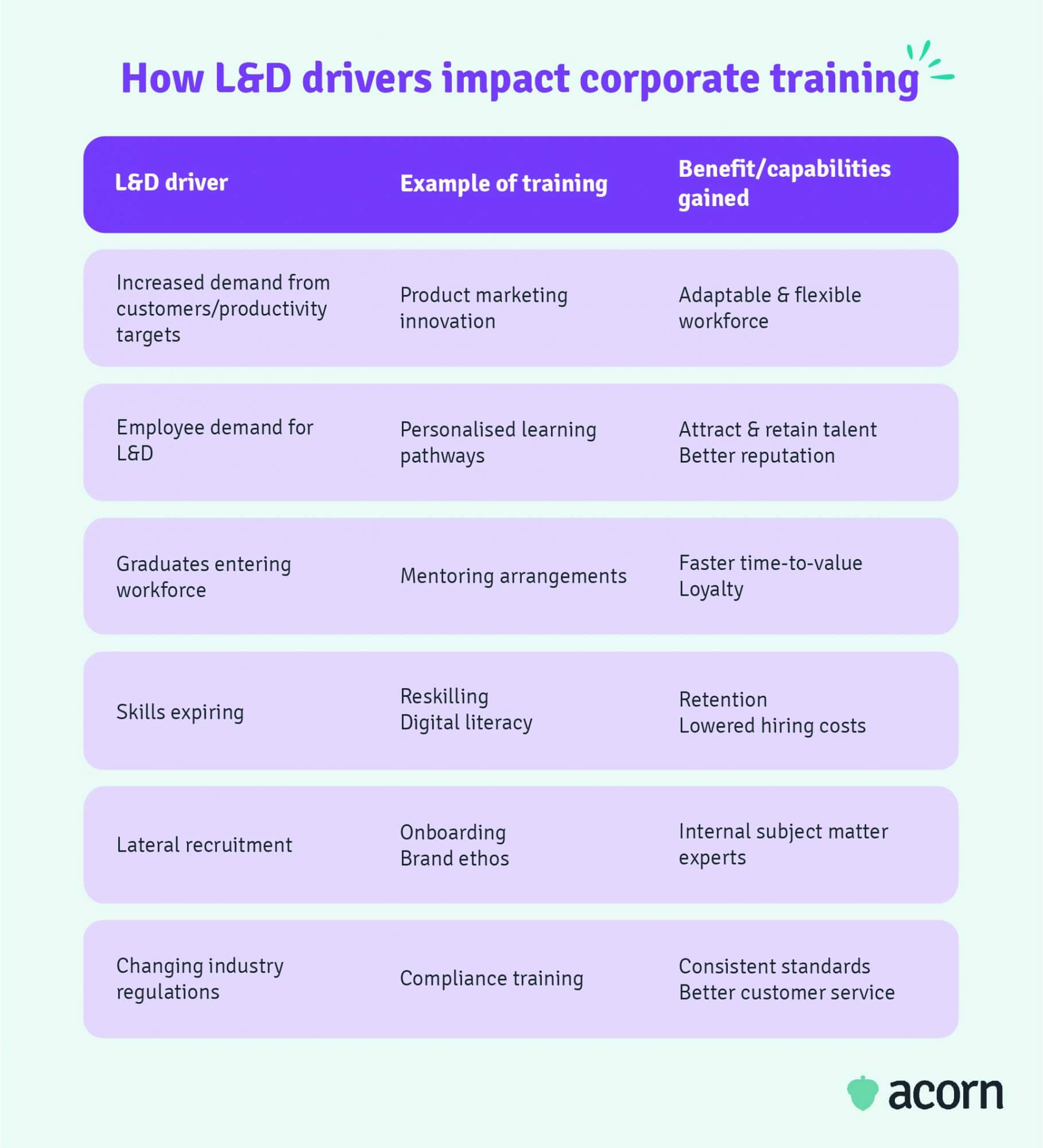
Don’t forget to consider environmental factors at this stage. Fast-moving industry changes, particularly technological, often dictate in-demand skills. Economic uncertainty changes the job market and availability of external talent (all the more reason to have a solid capability framework and plan to develop internally). Your CEO will emphasize certain directives and, therefore, change the urgency for certain capabilities. Younger generations want professional development, and they’re not afraid to job hop to find it.
As priorities shift, the framework provides a stable reference point for adjusting learning and workforce plans without losing alignment.
For example, the Australian Securities & Investments Commission uses a capability-led approach to create clearer expectations around performance and development, aligning learning activity to the capabilities regulators actually need to perform their roles effectively.
Support on-the-job performance
Capability development doesn’t happen in isolation. In fact, 90% of learned knowledge is forgotten within a week.
Most often, learning fails because it isn’t reinforced after training, or because it’s designed to live outside the flow of work. When learning is treated as an event (a course, a program, a compliance cycle), employees are left to translate abstract content back into real situations on their own.
A capability framework helps shift this by making learning usable in context. Content becomes something people go to as questions arise when L&D is treated as an everyday tool—more like a self-service FAQ than a quarterly intervention.
In this model, content isn’t the destination; it’s the reference layer. It provides quick guidance, examples, and reminders at the point of need, helping employees make better decisions and reinforce capabilities as they work—rather than trying to recall what they learned weeks earlier.
That reinforcement is strongest when it’s paired with real work moments. Manager feedback, examples of completed work, and evidence shared during assessments help ground that reference content in reality, showing not just what to do, but what good performance actually looks like in practice.
The added benefit here is consistent iteration of business performance. When capability development is reinforced through real work moments—feedback, examples, and evidence captured as work happens—content stays aligned to how work is actually being done.
Evaluate learning effectiveness
Traditional learning metrics focus on activity: course completions, attendance, time spent in the system. While useful for system administration, they say very little about whether learning is improving performance.
Capability frameworks introduce a clearer line of sight between learning and outcomes. Because capabilities are defined with expected levels of proficiency, learning can be evaluated based on whether individuals, teams, or functions are progressing toward the level of performance the business requires.
This helps you identify which course addresses which learning outcome, and gives you a measure of effectiveness. As an example:
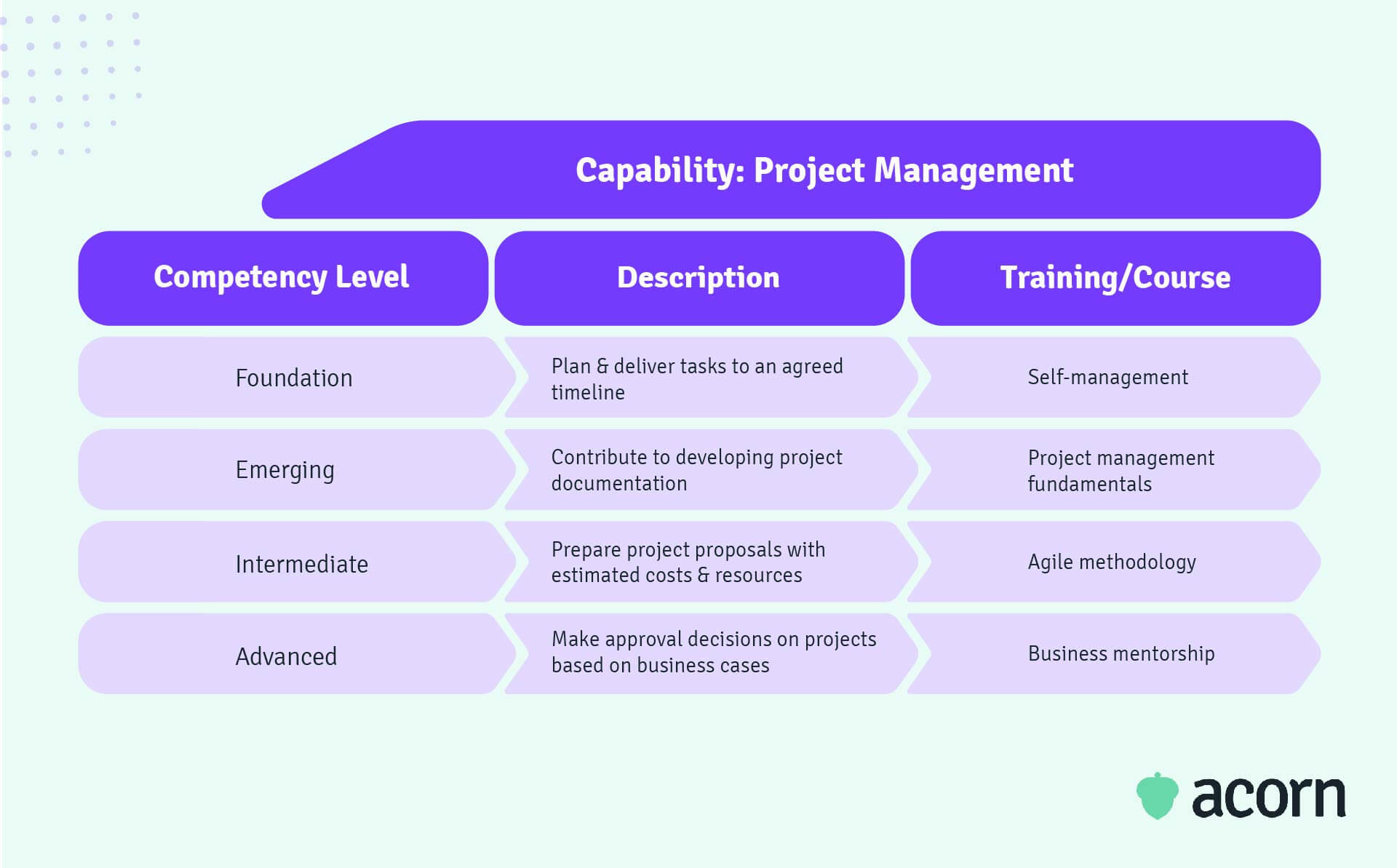
If you’re using a learning solution like a PLMS (performance learning management system), you can map learning content directly to competency levels, not just capabilities. Let’s say an employee, Joel, completes a capability assessment and is evaluated at the foundational level of competency for the capability Change Management. However, his job role requires him to work at an advanced level. Within Acorn, Joel would be immediately assigned content mapped to the intermediate level of Change Management.
Not only does this make it easier to track development for individuals, but it:
- Reduces time to proficiency in role
- Ensures consistency of performance across teams
- Improves readiness for more complex or higher-risk work
- Leads to fewer capability gaps over time.
Rather than asking, “Did people complete the training?”, the question becomes, “Did capability improve in the areas that matter most?” Over time, this creates a more credible evidence base for L&D—one that supports decision-making, prioritization, and conversations with leadership about where development investment is actually delivering value.
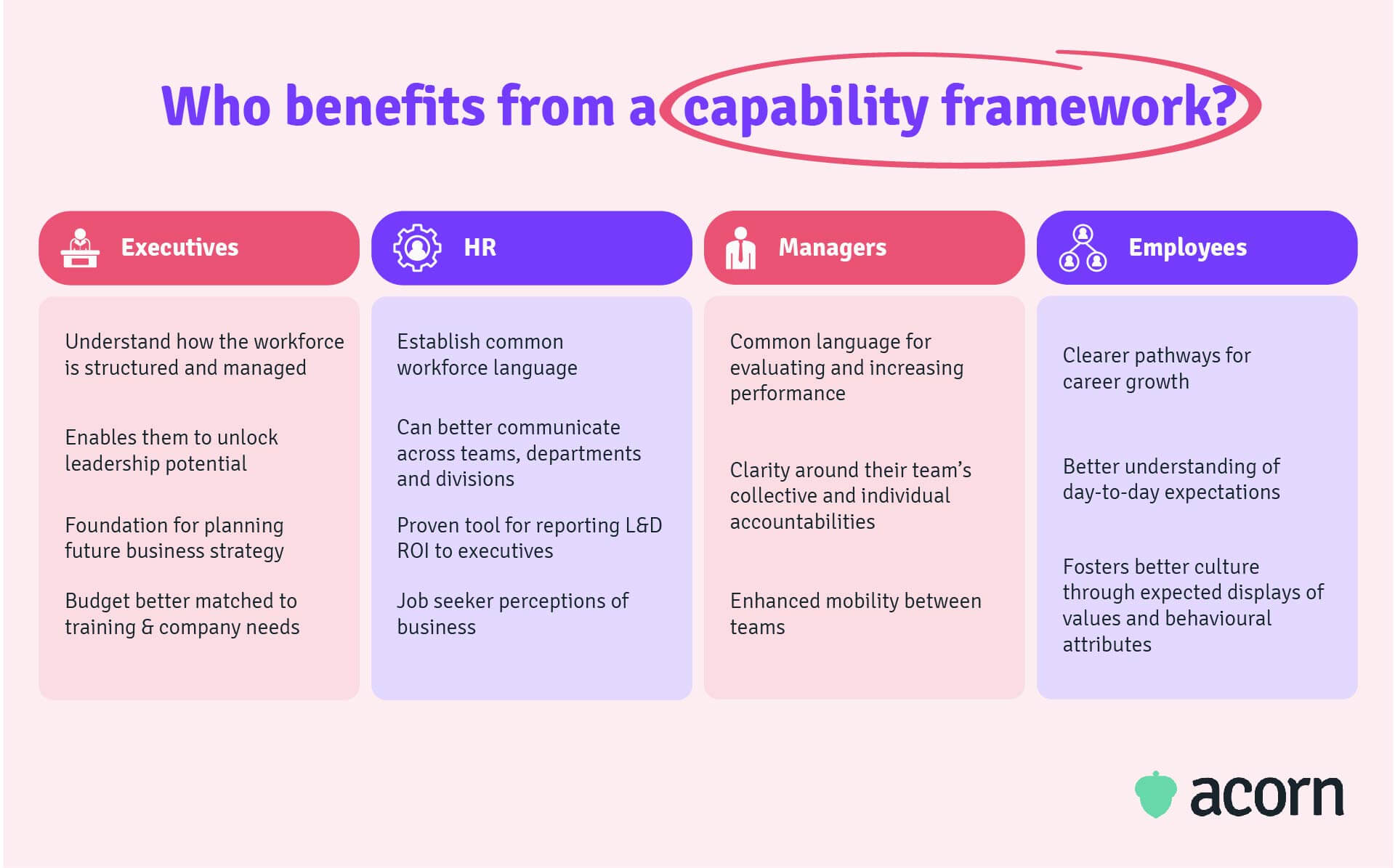
How managers can use capability frameworks
Capability frameworks aren’t just an HR artifact. The real value of capability frameworks for managers comes from replacing ambiguity with a shared understanding of what good performance looks like, how it shows up in work, and how it progresses over time.
Job role design
Clear roles are the foundation of strong performance. Capability frameworks help managers define roles based on outcomes and expectations, not just task lists.
By anchoring job descriptions to capabilities and proficiency levels, managers can be explicit about what success looks like at different stages in a role. This reduces misalignment early, shortens time to productivity, and creates a clearer path for development as responsibilities grow.
Recruitment and internal mobility
For managers, capability frameworks take a lot of guesswork out of hiring and internal moves.
Instead of defaulting to resumes, years of experience, or gut feel, managers can recruit against clearly defined capabilities and expected levels of proficiency. If you add in capability assessments, they can understand the development needs of new hires.
The same logic applies internally. When capabilities are mapped consistently, it becomes easier to identify employees who are close to role requirements, understand where development is needed, what gaps need to be addressed, and whether a move is realistic without setting someone up to fail. That equals fewer mis-hires, clearer development plans for internal candidates, and more confidence when making decisions that directly affect team performance.
Performance conversations
Capability frameworks make performance conversations easier and less emotionally loaded for managers by:
- Creating a shared definition of what good performance looks like, so managers aren’t relying on personal judgment or changing standards between team members.
- Anchoring feedback to the specific capabilities and proficiency levels of each employee’s role, making conversations feel fair, objective, and consistent.
- Clarifying what needs to change, since gaps are described in terms of capability progression rather than vague traits like “attitude” or “initiative.”
- Enabling focused development actions by linking feedback to concrete next steps (for example, moving from “developing” to “proficient” in a defined capability).
- Reducing emotional strain with explicit and documented expectations, removing the need for managers to soften or over-explain difficult feedback.
The result is fewer high-stakes, uncomfortable conversations and more grounded discussions that managers can approach with clarity and confidence.
How employees can use a capability framework
A capability framework is not something to be shrouded in C-Suite mystery. A sustainable and successful business relies on employees knowing what they need to do and when they need to do it.
When performance expectations are unclear or inconsistently applied, employees are left guessing what matters—and that uncertainty erodes confidence. Our research found 33% of employees said their last performance review felt like a bureaucratic tick-box exercise, and 29% said it made them feel anxious or stressed, largely because expectations weren’t clear or meaningful.
A capability framework improves the employee experience by giving people clearer signals about performance, development, and progression. Specifically, it helps employees:
- Understand what good performance looks like in their role, so they’re not guessing how their work will be judged
- See how expectations change as they progress, making career growth feel tangible rather than vague or political
- Focus development on the capabilities that matter most, instead of spreading effort across generic or low-impact learning
- Advocate for themselves in performance conversations, using shared capability language to discuss strengths, gaps, and readiness for more responsibility
- Explore capabilities beyond their current role, supporting lateral growth, stretch opportunities, and career mobility
- Plan realistic progression goals by understanding which capabilities open doors to future roles or higher levels of contribution
- Connect learning to real work, so development reinforces how work is actually done.
When employees can clearly see what’s expected, where they’re progressing, and what opportunities are available next, performance stops feeling subjective. Confidence increases, development becomes purposeful, and employees are better equipped to take ownership of their growth.
Important, when you consider that a large portion of the workforce does not feel prepared for the future of work, predominantly because they feel they lack the right capabilities.
A capability framework shows capabilities in simple terms for employees. Better yet, a capability framework within your LMS (or PLMS) shows capabilities in terms of career development.
Key takeaways
A workforce capability framework defines how work gets done across an organization. When designed and applied effectively, it becomes a shared system for performance, development, and progression.
Key things to remember:
- Capabilities define what good work looks like in practice, not just what people know
- Focus capabilities provide structure, grouping related performance expectations before roles or hierarchy
- Proficiency levels make progression visible, helping both managers and employees understand what “next” looks like
- Learning works best in the flow of work, supported by reference content and real-world evidence
- Performance conversations improve when expectations are explicit, reducing subjectivity and emotional strain
- Employees benefit from clarity, with the ability to advocate for themselves, explore new capabilities, and see realistic progression paths
- Organizations benefit from alignment, with clearer links between strategy, learning, and performance outcomes
Used consistently, a capability framework creates a common language for performance across the organization. It makes development purposeful for everyone by defining what’s expected, how to grow, and how their work contributes to outcomes that matter.