
Lead the pack with the latest in strategic L&D every month— straight to your inbox.
SubscribeI’m not big supporters of the skills focus myself. Skills are just too transient to make much of a difference to employee development long-term. Instead, we prefer to use capabilities.
Why capabilities?
The reason we use capabilities rather than skills? Capabilities are more stable and all-encompassing of what employees actually do to perform their jobs than skills are. Skills are a small part of capabilities (capabilities being the combination of skills, knowledge, behaviors, tools, and processes that deliver organizational strategy).
Did you know the lifecycle of a skill begins and ends within five years? That’s about two and a half years of good use out of a trained skill before they begin to become redundant, and you need to start providing more training to upskill (or reskill) employees further.
On the other hand, capabilities don’t go out of date. That’s because capabilities are measured on a scale of maturity or proficiency. Your people strategy that you know inside out right now probably won’t be the same strategy you need to have your head around in five years. There will be new tech, new processes, and new standards affecting your industry that will change how you approach that in your organization, not to mention the ways in which your organization may have grown, scaled, or pivoted in that time. Your people strategy hasn’t become redundant, it’s just had to mature, and capabilities have room for that maturity.
What makes capabilities the missing link
In a capability-led organisation, every job role has a set of core capabilities that outline what employees need to do to be successful in their roles. Those capabilities—and their assigned proficiency levels—are used as the basis for performance and learning.
- In terms of performance: assigned competency levels indicate what level employees should be performing their capabilities at, so you can see their strengths and development areas.
- In terms of learning: those development areas = places where learning should be assigned.
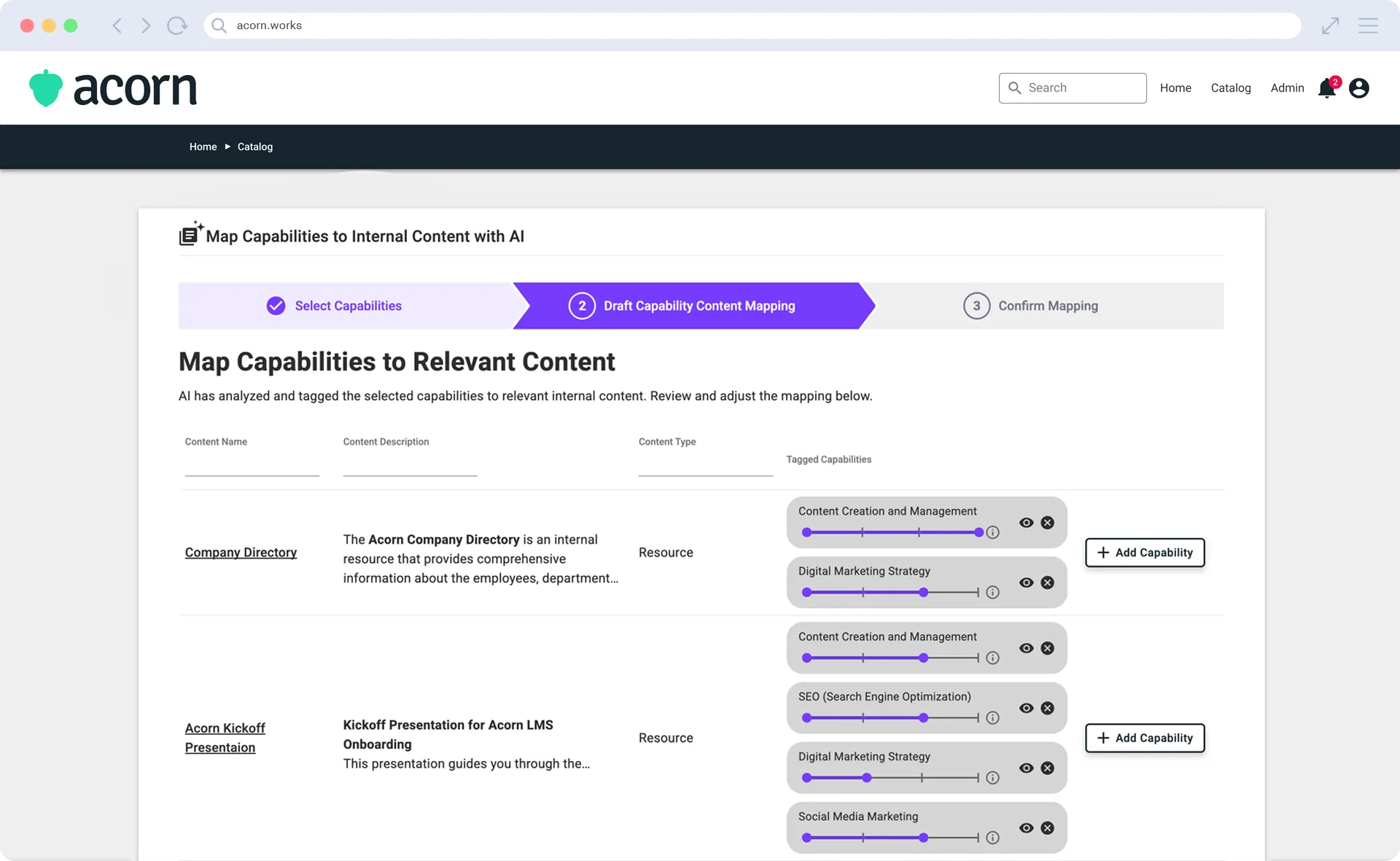
This is all easily said and done of course, but you may be wondering how you can be sure that training is actually addressing those development areas and gaps. Well, capabilities are mapped to learning. By that we mean that all capabilities are linked to relevant training courses that are specifically designed to build them.
It means you can build truly personalized development plans for your employees. Not everyone will have the same strengths or learning and performance gaps, after all, so why would you apply generic one-size-fits all training to everyone? But with personalized plans, everyone gets learning relevant to their own needs.
That might sound like a lot of work, but the idea is that you won’t have to manually put together development plans when you have capabilities mapped to content. AI can suggest training based on assigned capabilities and employees’ current proficiency levels. It gives time back to HR to work on more high-level tasks.
Plus, you can use capabilities to facilitate mentoring opportunities. Perhaps one employee is still developing one of their capabilities, but another is already an expert in that area. You can set up peer to peer learning between the two where the more experienced employee can help the other build their skills and knowledge.
This is super important because peer-to-peer learning is so crucial for fostering a culture of continuous learning, collaboration, and knowledge sharing. It means learners actually get learning that is relevant to them in the moment that they need it. It’s a different approach than having a huge content catalogue that learners have to sift through.
Ultimately, the idea is for capabilities to link learning and performance so that one informs the other (and vice versa), so both are stronger as a result.