
Lead the pack with the latest in strategic L&D every month— straight to your inbox.
SubscribeEver had a problem trying to get learners to actually engage with your LMS? If you consider how a lot of the professional development they went through in the past was likely just a lesson in compliance (i.e., setting training for trainings’ sake), it’s no wonder they lack interest. Why take time participating in learning that’s more than likely going to be more of the same pointless, irrelevant content?
There are a bunch of reasons for this. One of them is that a lot of companies put a lot of unnecessary emphasis on “more”. More content, more learning, more, more, more. They call their learning platforms “the Netflix of learning” because there’s such a vast catalogue of content to choose from. The problem there is that when you send your employees off to trawl those catalogues, they get overwhelmed by the amount of content available. They don’t even know what content is good—and why would they? They can’t know unless they already know what the learning is, so they switch off and disengage.
Secondly, a lot of the learning provided to learners just isn’t relevant to their needs. So many times, businesses make the mistake of assuming that everyone needs the same learning because they’re “doing the same job”, but that’s just not the case.
And then there’s the “what next?” aspect of learning. You send all your learners to your catalogue and maybe they find what they need, but where do they go from there? Meaningful performance evaluations and rewards and recognition are crucial in maintaining employee engagement. The issue is so many companies don’t give meaningful performance feedback or fairly reward employee achievements.
Capabilities in user-driven content creation
When we talk about improving employee engagement with learning, we’re talking about making it meaningful. And what better way to do that than by making learning that is actually useful and relevant to your learners? Capabilities lay the groundwork here, because each:
- Job has an assigned capability set, therefore
- Capability outlines what employees need to know for their jobs, and
- Capability is mapped to learning, so
- Piece of learning completed is relevant to individuals’ capability needs.
The key to making sure relevant learning works is to provide it at the right moment. It’s no use having content that applies to specific capabilities if the learners who need it can’t access it, or aren’t able to find it in your Netflix-esque catalogue. We’re solving this by creating the ability to record day-to-day interactions by employees.
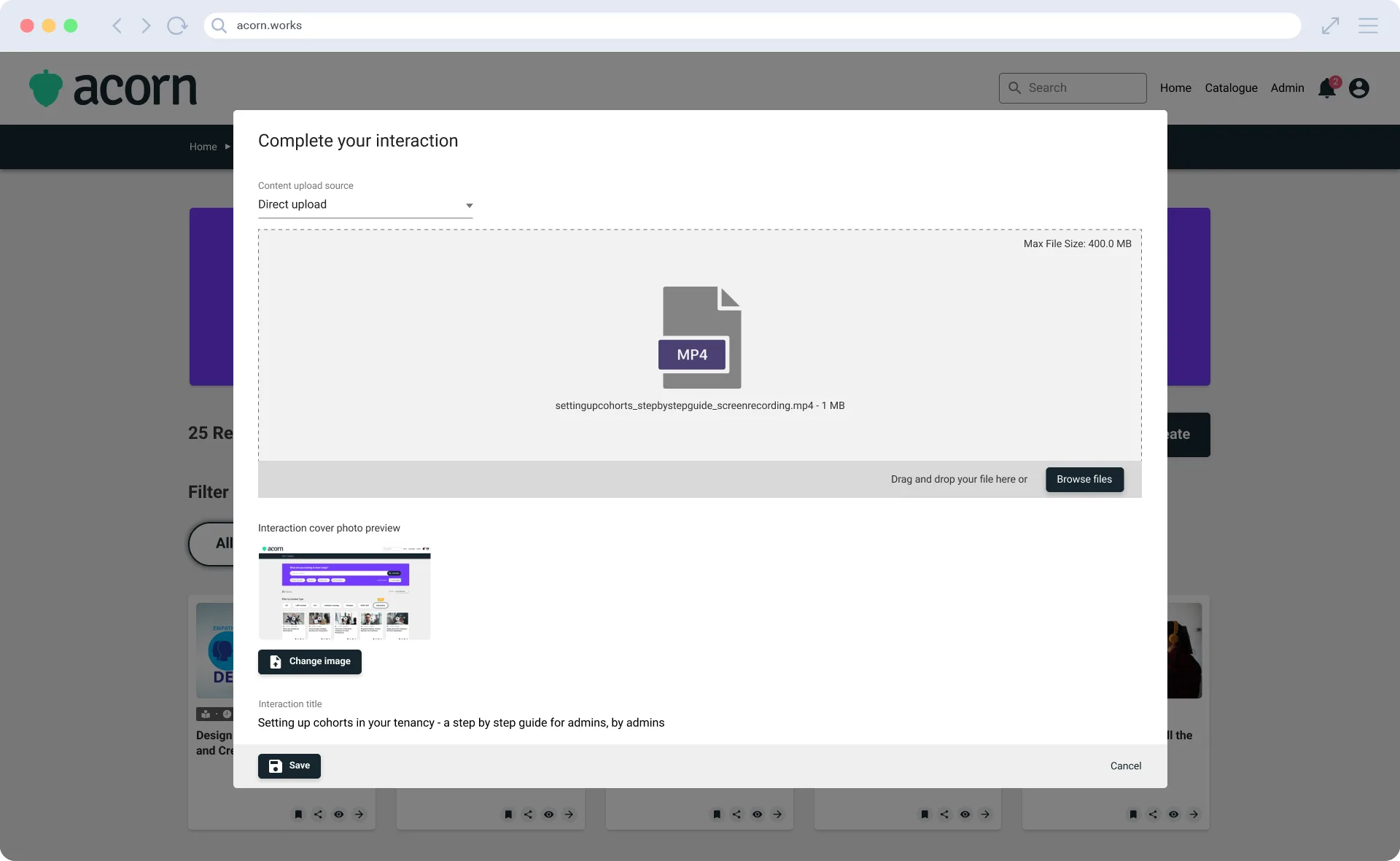
These aren’t planned interactions, they’re demonstrations of capability that occur naturally throughout the day. Maybe one of your customer service staff went above and beyond to identify and resolve a ticket. Maybe a salesperson turned a renewal into an upsell as well. These are examples of employees demonstrating and performing their capabilities, but they’re also interactions that can be saved and used by other employees in your business later. What’s more, they provide manager with clear, tangible evidence of employee performance so employees can get the feedback they need to improve (and the recognition they deserve for their efforts).
Let’s say someone on your sales team achieves an impressive upsell. This recording could be uploaded as an interaction so that when one of their colleagues does a sales, call, they might check out the recording of the upsell for insight into how they can turn what they’re doing into an upsell as well. What’s more, that recording can be referred to as evidence of the salesperson’s proficiency in their core capabilities, so they can be accurately recognized for their achievements.
Final thoughts
The key to getting employee engagement with learning is twofold:
- It needs to be relevant to them and what they do
- Learning needs to come to them at the right time.
By using recording day-to-day capabilities in action, people are going to find the exact learning they want at the exact time they need it, and apply that to their work.