What is a PLMS or Performance Learning Management System?
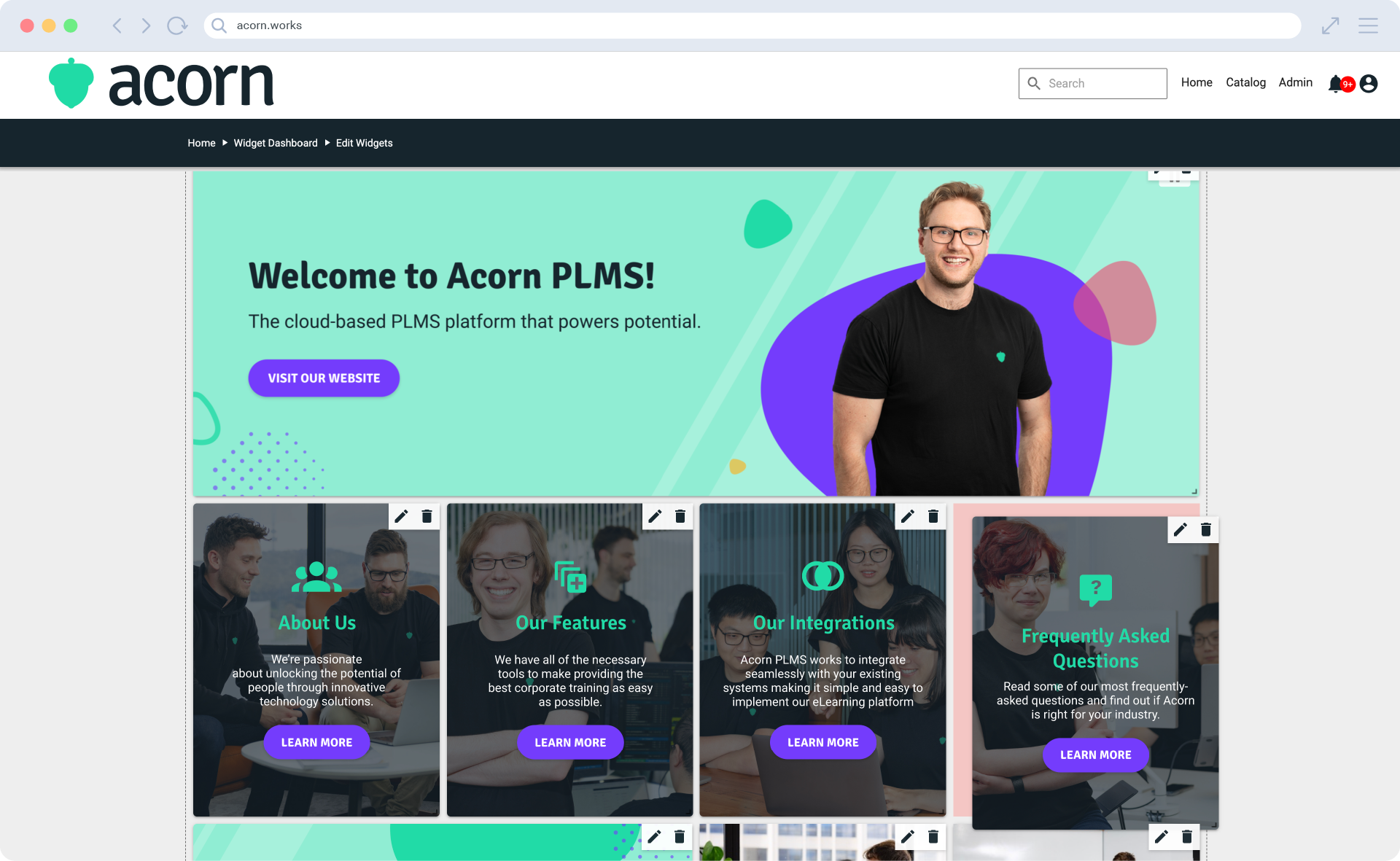
Get the industry accepted definition of a performance learning management system including all FAQs right here.
Most learning systems aren’t measuring what you need. They measure learning activity like compliance, logins, and completions, but they don’t tell you how learning impacts business outcomes. More and more, companies are realizing that learning activity metrics can’t help them achieve organizational goals. But the performance learning management system (PLMS) addresses what the traditional LMS has ignored: actual behavioral change.
Want to see Acorn PLMS in action?
Hit the book a free demo button, fill in your details, and find out how Acorn can help you succeed.
Why the PLMS, why now?
Our 2025 State of L&D and Performance Report found the toll of performance reviews is both human and organizational. 29% of employees leave reviews stressed, 27% uninspired, and 26% questioning their value. They only happen once or twice a year as a rear-view mirror exercise, rather than an opportunity to look to the future, and are based on the strength of a manager’s memory or subjective opinion. Employees feel judged rather than supported, and there’s rarely any actionable employee development. All because companies are spending hundreds of thousands on learning and performance systems that track outputs, and not outcomes.
You might think a learning management system (LMS) addresses that performance need, by giving people the training they need to improve. The reality is that while LMSs handle content delivery and compliance well, you can’t be sure that the content is relevant to what learners need to improve in their rolls.
The cracks show up in four familiar ways:
- Content overload. Too much learning, not enough relevance. With thousands of courses available and no means to validate their use, employees don’t know what’s valuable, and most of it never gets touched.
- Low adoption. Learners see courses as checkboxes, so they only log in and do learning when they have to. When systems don’t feel tied to their everyday work, they don’t get used.
- Data silos. Performance and learning data live in different systems. HR teams spend hours pulling spreadsheets to try to connect the dots, and managers still don’t have a clear picture of impact.
- Weak ROI stories. Executives want to see how well people are applying what they’ve learned, not just how many modules were launched or completed. Without that connection, L&D budgets are often the first to be cut.
To shift away from this, organizations need to draw a direct link between learning and performance. And that link is drawn with the foundation of the PLMS: capabilities. They’re the mix of skills, knowledge, behaviors, processes and tools that deliver organizational outcomes, and visibility into how people build their capabilities is what gives leaders more than just a subjective impression of behavior.
The PLMS does this in three key ways:
- Embedding learning within performance conversations. Managers can see what training was completed and how those capabilities are being applied on the job.
- Making reviews ongoing and data driven. Instead of waiting a year, leaders track progression against capabilities continuously in more frequent check-ins. This way, employees can make change behaviors as needed.
- Proving learning impact. Track capability and performance uplift, linking learning investments directly to business outcomes.
The outcome is a performance conversation that feels like progress, not punishment. Employees see a clear link between their learning and career growth, and leaders finally get the evidence they need to prove the impact of development programs.
The six core components of how a PLMS works
The PLMS sets itself apart from LMSs and PMSs with six essential functions that link learning and performance with capability. These six functions are:
- Pre-learning setup
- Learning management
- Learning assessment
- Embedded employee development
- Multi-stakeholder learning
- Workflow automation.
A PLMS has to have all six of these functions to truly be a performance learning management system.
1. Pre-learning setup
Where the LMS will simply manage and assess your learning, the PLMS dives into your strategy and goals before you even get started with content.
When you upload your organization’s job roles and descriptions, the PLMS will map those job roles to relevant capabilities (we use Acorn AI to do this) which draws from your own capability framework (if you already have one) or our proprietary Capability Library of 1,600+ capabilities and 5,000 proficiency definitions.
The PLMS also helps link those capabilities to learning content. That way, anyone will be able to find learning courses that directly tie to the capabilities they need to succeed.
This is a crucial aspect of the PLMS because it addresses the core issue plaguing L&D teams: learning not being linked to business outcomes. It means that no matter what you do, learning and performance managed within a PLMS is always tied to business goals.
2. Learning management
Learning management systems focus solely on the management of learning content and completions, whereas PLMSs go one step further and link learning to measurable performance outcomes.
Instead of juggling different systems or spreadsheets, a PLMS keeps all learning data in one place. That includes online modules, classroom sessions, mentoring, coaching, and even informally shared knowledge from peer to peer, which are all managed in a single learner profile. It’s designed to be easier for employees to find the content they need when they need it, instead of having to bounce between different platforms.
3. Learning assessment
Completions only reveal how many people have finished learning content, not whether they have retained or used what they learned. You can’t use that data to calculate training ROI, or determine what capabilities to prioritize.
A PLMS assesses the impact of learning, i.e., whether learning has helped develop capabilities and uplifted performance. Leaders can see baseline proficiency, measure changes over time, and spot capability gaps across the team or organization as a whole.
Progress is visible in one dashboard, so instead of saying “X people finished a course” you can report tangible metrics like “X people improved their proficiency in Y capability”. That’s the kind of evidence executives care about when deciding if learning is worth the investment.
4. Embedded employee development
The reason performance management gets a bad rap is because it’s totally disconnected from daily work. People see it as only looking backwards, and opportunities to improve or develop over the performance cycle are passed over. The result is employees feel their time is wasted, and their careers are stagnating.
The PLMS makes capability data the foundation for regular performance conversations and one-on-ones between managers and employees. Instead of giving subjective ratings, managers can not only see how someone is progressing, but coach them to do the things needed to improve. That makes for more confident leaders, and happier, nurtured employees. Internally at Acorn, we run capability assessments every quarter and one-on-ones every one to two weeks. It keeps feedback timely, development visible, goals tangible, and the performance conversation fair and rooted in a person’s actual impact throughout the year, as well as what they can do next based on their capabilities.
5. Multi-stakeholder learning
Organizations rarely train a single audience. Customers, partners, and members all need access to tailored learning. Even within a single organization, the needs of entry-level workers, middle managers, and executives will vary. A PLMS makes this possible within one system, using multi-tenancy and customizable portals.
This solves two common problems. First, it reduces cost and complexity by avoiding multiple systems for different audiences. Second, it ensures each group sees the content that matters to them, whether that’s employee training, partner enablement, or customer education. It makes it easier for learners to find what they need when they only need to scroll through the content that pertains to their specific needs.
6. Workflow automation
The hidden burden of most learning and performance processes is the admin. Chasing completions, reminding people about reviews, and managing onboarding manually eats up time. PLMSs cut the time it takes to do all the admin work by automating these tasks with workflows to provide timely nudges, so learners always know what to do next. For leaders, it removes the headache of spreadsheets and manual follow-ups, freeing them to focus on coaching and strategy.
Where LMSs automate course enrollment, and performance management systems (PMSs) automate review cycles, a PLMS covers both. It ensures learning and performance processes run smoothly together to reduce admin, increase adoption, and keep the focus on growth rather than bureaucracy.
PLMS FAQs
Want to know more about how the performance learning management system (PLMS) works in current organizations?
Is a PLMS right for our organization if we’ve only just started exploring capability building?
Performance learning management systems are perfect for organizations just starting in capability development, or even in organizations that are thinking about it but aren’t ready to commit to a capability strategy yet.
Because the PLMS covers the full stack of learning and performance management, you can start with core LMS functions and then grow into capability-led performance from there without outgrowing your platform as your maturity increases.
If our organization is focused on building skills, is a PLMS still right for us?
We’ve seen the big trend towards being a “skills-based organization“, and while skills matter, they’re only part of the picture. Skills are pretty transient, only having a short shelf life before they begin to become obsolete (especially now with AI). In that sense, focusing on skills makes L&D more expensive, and means you’re just focusing on upskilling over and over rather than developing anything strategic.
At Acorn, we advocate for capability-led strategy instead. Capabilities combine skills with knowledge, tools, behaviors, processes, and systems, based on what is needed to achieve your business strategy. That’s what makes capabilities a stronger measure of impact. Skills certainly help drive performance, but they can’t do it in isolation.
If you use Acorn PLMS, you have three options for getting started with capabilities:
- Build your own capability framework from our library
- Import your existing capability framework and definitions
- Use an industry standard like SFIA.
Is a performance learning management system just another marketing play-on-words?
The short answer is no. While a PLMS encompasses some of the LMS and PMS functions, it’s its own category that can work with your existing tech stack. The PLMS sets relevant learning up on a basis of capabilities and assesses performance uplift from that learning.
If a vendor:
- Only manages and assesses learning, they’re an LMS.
- Offers the assessment front-end, they’re an assessment provider.
- Only runs review and goals cycles, they’re a performance management system.
- Manages and assesses learning, and offers a separate performance or skills management module (even if it’s API integrated) then they’re a provider of separate LMS and PMS platforms.
- Only offers the management and assessment of multi-stakeholder learning, they’re a traditional LMS for internal and external use cases.
If you’re evaluating providers, you can these questions to determine whether you’re dealing with a PLMS or not:
- Can the provider discover, define, assess, and map the organizational and role-based capabilities of your learners?
- Can they manage all learning opportunities in a single learner profile, including e-learning, coaching, mentoring, in-person courses, and informal knowledge-sharing?
- Can they deliver reporting on both learning metrics and reassessment of organizational and individual capabilities?
- Can they provide capability-led performance enablement functionality within the software itself, not through a bolt-on integration?
- Can they support multi-tenant learning environments for different stakeholders (employees, partners, customers, members)?
- Can they automate workflows so leaders can focus on performance, not administration?
- Is the provider’s vision capability-led, helping people understand the capabilities their role requires and how to build them?
If the answer to all of the above is yes, then the provider is a PLMS. If they’re only focused on skills, content delivery, or process management, then they’re not a PLMS. LMSs and PMSs have their place as platforms within organizations’ HR tech stack, but only the PLMS is designed to connect capability growth with organizational goals.
Where does a PLMS sit in your organization’s current HR tech stack?
The PLMS acts as the foundational platform across your organization.
Today, HR uses and manages fragmented tools for onboarding, learning, performance, retention, and workforce planning. Each solves a narrow but important functional problem—they just don’t address whether people can actually do what the business needs. What’s more, that patchwork of tools isn’t able to communicate with each other in the same language. As it is, HR has no cohesion to inform any decision-making.
A PLMS replaces that patchwork with one foundation. By anchoring on capabilities, it connects strategy to roles, roles to development, development to career progression, rewards and recognition, and career progression to workforce planning. Where the LMS or PMS manages a small piece of the pie, a PLMS ties all people processes back to business goals.
Why choose a PLMS over an LMS or PMS?
LMSs and PMSs were built for narrow functional goals. An LMS manages training courses and completions. A PMS manages job scorecards and ratings. Each serve important functions, but don’t connect development to what the business actually needs for success.
A PLMS takes a different approach. It doesn’t do your performance management for you, but it does give you the foundation to make your performance management meaningful. It takes your business goals and identifies the capabilities your organization needs to deliver on them, including the capabilities needed for each role. Learning is managed and assessed against those capabilities, so it’s always connected to real outcomes, not just completions and compliance.
LMSs tell you who finished a course, and PMSs manage ratings. But a PLMS shows you whether people have built the capabilities that matter to your business. If you’re looking to make that connection between your L&D practices and better business outcomes, then a PLMS is what you need.
How is AI incorporated?
LMSs often use generative AI to, well, generate more content. At Acorn, we don’t think more content is necessarily good content. Rather, relevant content is king. Instead, PLMS’s use AI to automate tedious, time-consuming, and cost-intensive tasks, like:
- Analyzing your strategy and suggesting the capabilities that matter most
- Mapping capabilities and proficiency levels to learning content, so everyone can find content that is relevant to them
- Bulk-mapping capabilities and proficiency levels to cohorts, so teams with shared tasks or roles can quickly be assigned the same capabilities
- Recommending content to every individual learner based on proficiency levels.
Learning technology definitions
Learning technology definitions
For clarity, you can check the definitions of legacy learning management and performance management systems below.
What is a learning management system?
A learning management system (LMS) is a software application or web-based platform designed to facilitate and manage the administration, delivery, tracking, and assessment of educational courses and training programs. It serves as a centralized hub where instructors can create and organize course content, communicate with learners, and track their progress.
What is a performance management system?
A performance management system is a structured process and set of activities designed to monitor, assess, and improve the performance of individuals and teams. It involves establishing clear goals and objectives, defining performance expectations, measuring progress, providing feedback, and taking corrective actions when necessary.
The bottom line
The performance learning management system (PLMS) is the key to start measuring what matters for organizational strategy. Instead of tracking participation, outputs, and completions, it instead focuses on tying learning to performance, outcomes, and capability.
Want to learn more about Acorn PLMS and how it can server your business? Set up a call with a member of our team and we’ll show you how Acorn can help your business get ahead with linked performance and learning.