New Research: The Massive AI Fluency Blindspot Your C-Suite Can’t See
Reading Time:
Lead the pack with the latest in strategic L&D every month— straight to your inbox.
SubscribeNew research shows employees aren’t being given what they need to build real AI fluency.
Ask the C-suite how the AI rollout is going, and you’ll get one answer. Ask the people doing the actual work, and you’ll get something close to the opposite.
Acorn’s 2026 State of Learning for AI Fluency report finds 78% of executives said AI expectations are communicated very well at the role level. Only 19% of individual contributors agreed. That’s a 59-point gap, and it isn’t a difference of opinion. It’s two organizations operating inside the same building.
If you’re trying to work out why your AI program is everywhere on the dashboard and nowhere in the work, this is where to start.
What is the AI fluency gap?
The AI fluency gap is the measurable difference between what leadership believes the rollout of AI has delivered and what individual contributors actually experience day to day. AI fluency itself is the ability to apply AI tools effectively to the specific requirements of a role, which makes it role-specific by definition.
The 2026 research shows the same hierarchical pattern across every measure:
- 78% of executives say AI competency expectations are communicated very well at the role level, compared to only 19% of individual contributors.
- 77% of executives say managers are very prepared for AI capability conversations, compared to 9% of individual contributors.
- 78% of executives are very confident their current approach will prepare the workforce for AI-driven role requirements over the next three years; 41% of individual contributors are not at all confident.
The further you sit from the work, the more confident you are that the program is doing what leadership thinks it’s doing. And 58% of organizations report seeing employees who can use AI tools in general but struggle to apply them to the requirements of their specific role, which is the practical evidence that general AI proficiency hasn’t translated into role-level fluency.
Why development plans aren’t building AI fluency
The infrastructure organizations are using to build AI fluency is the same infrastructure that’s been failing traditional skills development for years. The 2026 report clearly shows the underlying measurement failure:
- 58% of organizations say their development plans are somewhat, not very, or not effective at improving performance and building skills.
- 61% struggle to connect learning activity to measurable improvement in job performance.
- 77% treat training completion as evidence of capability.
- 64% aren’t completely confident their current approach can answer one basic question: are employees getting better at their jobs?
Development plans are nearly universal, but they’re built without role-level standards, so measurement stops at completion. The same approach now extends to AI: deploy the tool, complete the training without a measurement layer for whether the actual work has gotten better.
The 2026 data also finds that 83% of respondents see a disparity between what employees claim about their capabilities and what they demonstrate in practice. Without a measurement layer that can answer “what can this person actually do?”, performance and promotion decisions are running on perception.
Why AI rollouts are happening without role-level infrastructure
Gartner data shows AI-related spending growing at a 50%+ CAGR, with indirect AI services alone projected to reach $255.9 billion in 2026. But (and it’s a big but), only 28% of AI use cases fully succeed and meet ROI expectations.
The reason for the disconnect: companies are deploying tools without defining what AI fluency means at the role level. The 2026 data shows it across the org chart:
- 73% of executives say their organization has a clear, organization-wide AI strategy actively being executed.
- 36% of individual contributors have received zero direction from their organization on how to use AI in their role.
- 53% of individual contributors say they’ve received no direction or no actionable next steps.
AI strategy is being declared at the top but improvised at the front line. Most organizations track AI use by tool usage frequency, not whether the work is producing better outcomes, which means leadership keeps reporting a healthy rollout while ROI doesn’t materialize and employees don’t know what they’re supposed to be doing differently.
Why most organizations can’t measure AI fluency
You can’t measure something you haven’t defined. The 2026 report shows where the absence of definition sits inside organizations:
- 34% of organizations haven’t defined AI competencies at the role level at all.
- 23% have no clear owner for who’s responsible for defining what AI fluency looks like for specific roles.
- 47% haven’t included AI capability in formal performance reviews.
- 30% have no formal mechanism to assess and track AI capability at the individual employee level.
The downstream effect is that employees fill the definition gap themselves. Without a role-level target or formal assessment to anchor to, good AI use becomes whatever each individual decides it should be, which is the patchwork of shadow AI most organizations are now trying to wrangle.
Manager preparedness follows the same hierarchy as the rest of the perception gap. 77% of executives think their managers are very prepared for AI capability conversations. 34% of managers and 9% of individual contributors agree. Closing that gap takes giving managers the same defined target their employee is being measured against, not more manager training.
The 59-point gap in role-level communication is a downstream symptom of all this. AI fluency can’t be communicated, measured, or built on top of a standard that hasn’t been defined.
How to close the AI fluency gap
The data is consistent on what works. 56% of organizations with effective development plans say the reason is the same: their plans are tied to measurable, role-level capabilities. The organizations breaking the pattern:
- Define AI fluency at the role level before deploying tools. No training program delivers against a target that hasn’t been set.
- Connect AI capability to business outcomes, not the training catalog. Only 41% of organizations have built a direct link between what employees develop and what the business needs. The ones who have are the ones who can answer whether learning is working.
- Give managers the same defined standard that their employees see. That’s the only way to make the capability conversation about something real.
- Measure capability change, not training completion. 73% of organizations with systematized capability frameworks are confident in their promotion decisions, because they’re measuring what people can do, not what they’ve finished.
The bottom line
Underneath every finding in the 2026 data is one structural issue: most organizations haven’t defined what AI fluency looks like at the role level, which means it can’t be communicated, measured, or built consistently.
- The gap is consistent across the org chart. 78% of executives say AI competency expectations are clearly communicated at the role level; 19% of individual contributors agree. The same pattern shows up on manager preparedness and three-year workforce confidence.
- The measurement model is broken. 77% of organizations treat training completion as evidence of capability, which is the central reason AI investment isn’t translating into measurable productivity gains.
- Communication closes the gap once there’s a defined standard to communicate. 34% of organizations haven’t defined AI competencies at the role level, which is why the 59-point communication gap persists.
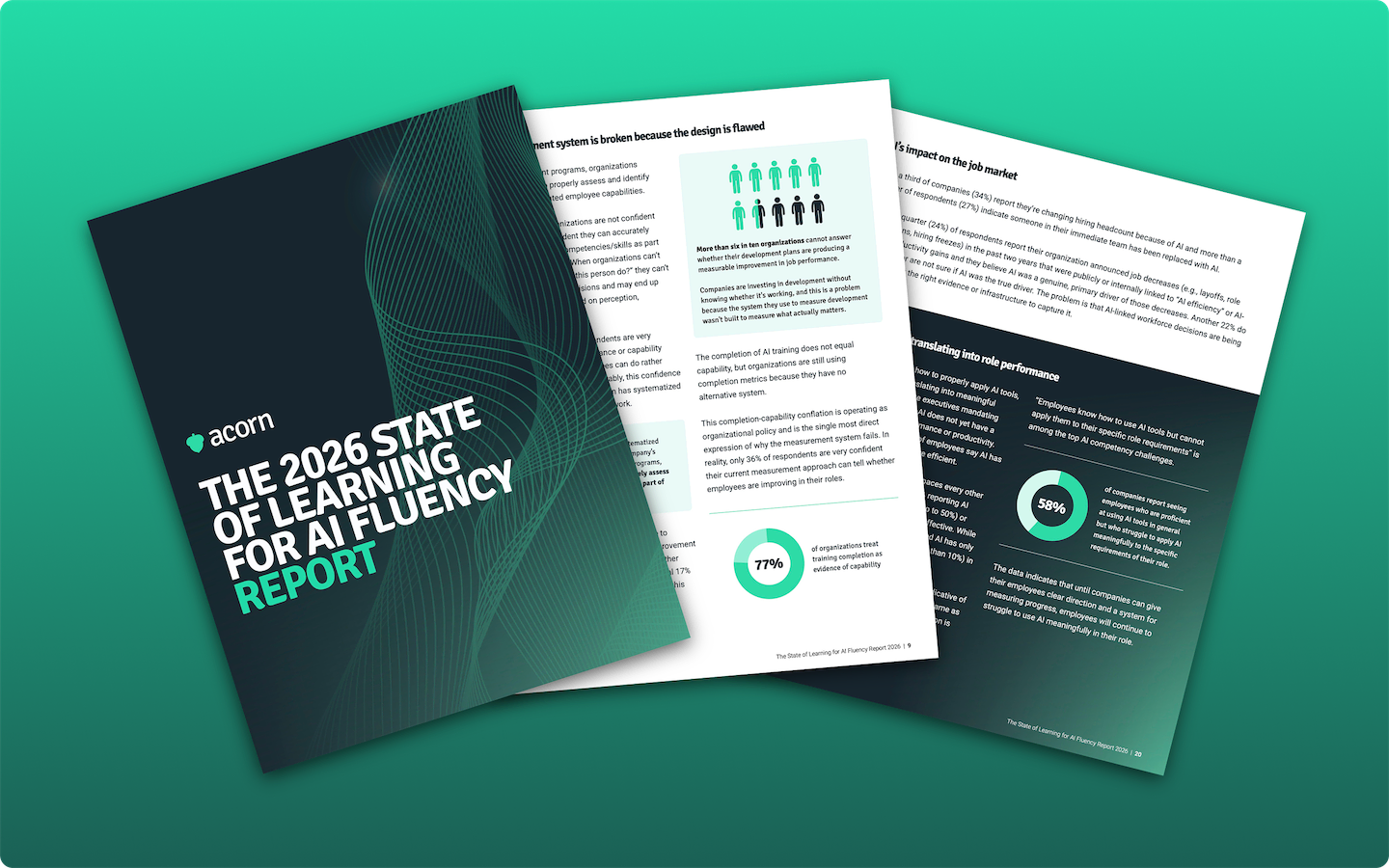
Get the full data, methodology, and breakdowns by role and organization size in the 2026 report below.