How to Write a Professional Development Plan that Doesn’t Go Stale
Reading Time:
Lead the pack with the latest in strategic L&D every month— straight to your inbox.
SubscribeSomewhere in your organization, there’s a folder of drafted development plans.
Most of them were written thoughtfully. Almost none have been opened since.
Acorn’s 2026 State of Learning for AI Fluency Report found that 58% of organizations describe their development plans as less than effective at improving capability.
Every guide on this topic will hand you a structure: a goal, some activities, a timeline. The harder question is what keeps a plan in use once the writing is done.
It comes down to four things: who owns it, the learning activities, when it’s revisited, and how you prove it worked.
TL;DR
- A professional development plan sets out what a person wants to be able to do, what their role or field requires to get there, the activities that will build it, the evidence it happened, and when it gets revisited.
- Plans fail after they’re written, not while: 58% of organizations describe their development plans as less than effective at improving capability.
- The individual authors the plan; the manager’s part is context, access to stretch work, and coaching.
- A plan cannot be only online courses; roughly 70% of development comes from challenging work and 20% from other people, per the Center for Creative Leadership’s 70-20-10 model.
- A professional development plan and a performance improvement plan (PIP) are different documents with different stakes, and running them on the same form makes people cautious toward both.
What is a professional development plan?
A professional development plan is a written plan that sets out the skills an individual wants to build, the activities that will build them, and how they’ll know it worked.
The word doing the work in that definition is professional. A personal development plan can cover anything you’d like to be better at, from public speaking to sourdough. A professional development plan is anchored to what your work, field and organization require, and that anchor is what makes progress tangible.
People usually write professional development plans for one of four reasons:
- A new role
- A role that changed underneath them
- A review cycle that asked for one
- Ambition with no obvious route from here to there.
That last reason is one that many organizations overlook. The form matters less than the habit it creates. A plan exists to make development real, repeatable, and driven towards a mutually beneficial goal for the individual and the organization.
Professional, individual, employee, career: which plan do you need?
Four names circulate for overlapping documents, and choosing between them takes about thirty seconds.
| Plan | Who writes it | Horizon | What triggers it | What it isn’t |
|---|---|---|---|---|
| Professional development plan | The person it belongs to | 6 to 12 months | A goal, a new role, or a role that’s changing | An assessment of how someone is doing |
| Individual development plan (IDP) | The person, with their manager | 3 to 12 months | A gap between the person and what their current role requires | A career map |
| Employee development plan | The organization sets the format; the employee fills it in | Usually annual | A program rollout, often tied to review season | A plan anyone owns by default |
| Career development plan | The person | 2 to 5 years | An ambition about where they’re heading | A plan for this quarter |
| Performance improvement plan (PIP) | The manager, usually with HR | 30 to 90 days | A shortfall against role expectations | A development plan of any kind |
Two columns in that table are doing the real work: who writes it and what it isn’t.
A professional development plan isn’t an assessment of how someone’s doing in real time, and that gap is wider than it looks. An assessment belongs to the organization by design. The standard for a role, the read on where someone sits against it, the review calendar: those exist so the business can compare, and they’d be useless if everyone kept a private version. A plan runs the other way. It’s what the person decides to do about that read, and LinkedIn’s Workplace Learning Report 2025 puts career progress as people’s number one motivation to learn. Fill the plan in for them and you’ve written over the part doing the work.
That leaves the manager with the part the individual can’t do alone.
- Bring the business context. “We’re going to need someone who can run the client pricing conversations by Q3” puts a real option on the table. Whether it becomes a goal is still the individual’s call.
- Open doors to the work. The Work row only exists if somebody hands over the project, the meeting, or the account. It’s the part managers most often skip, and the part only they can do.
- Keep the conversation alive. Fifteen minutes in the 1-on-1 every few weeks, and saying out loud that the time is worth spending.
Why professional development plans fail
Rome wasn’t built in a day, and the same goes for any skill or capability. It takes time, discipline, and space to develop new skills, which is why many development plans fail to get off the ground.
- Treated as a writing exercise. The plan came out of review season as an output, so it never became an input to anyone’s actual week.
- Top-down approach. Someone else set the goals. When they slip, nobody feels the loss.
- Made entirely of courses. Every activity is a click-through module, and those are the first thing a busy quarter clears.
- No review date. A plan without a next date is a wish with formatting.
- No success measures. Nothing in the plan says what proof would look like, so “done” quietly becomes “attended.”
Failures two and three are the ones people underestimate. Deloitte’s 2026 Global Human Capital Trends found workers are twice as likely to feel negatively about an employer-imposed change as one they chose themselves, and the top challenge leaders face is change not seeming relevant to the individual. SHRM’s 2026 Talent Trends Report found job rotation rated 93% effective at addressing talent gaps yet used by fewer than a quarter of orgs. The most effective development lever going is the one least likely to show up in a plan.
Failure five is structural. Acorn’s 2026 report found 77% of organizations treat course completion as proof that a skill exists, largely because they have no other success measures.
Then there’s the objection that beats all five of the above put together: nobody has time for this. Harvard Business Review found that development conversations should center on near-term opportunities and on learning built into the daily work.
Development that sits on top of the job loses to the everyday work, every time. That’s if you don’t build the work into the plan.
What goes in a professional development plan
An effective plan needs five things: a goal, the standard you’re aiming at, the activities that get you there, the evidence it happened, and a review date.
Most templates carry the first three and stop. Don’t worry—we’ve got you.
1. The goal, written as something you’ll be able to show
“Improve my data skills” is a vague concept. “Be able to run the quarterly forecast review and defend the assumptions in the room” is a goal, because both you and someone else could tell whether you’d done it.
SMART goals are the usual convention: specific, measurable, achievable, relevant, time-bound. Measurable is the one people skip, and it’s the one that decides whether the goal can ever be reviewed. A good way to pressure-test it: write the goal so a colleague who wasn’t in the conversation could look at your work in six months and say yes, they can do that now.
2. What the role or the field actually requires
A goal needs something to measure itself against, and this is the part most people guess at. Look at the job description for the role you’re aiming at, the level above yours, or what your profession expects at this stage.
What matters in those descriptions is the proficiency level, not the skill name. Most frameworks describe the same skill at several levels, separated by how much help you still need: with support, on your own, or well enough to teach it. “Client scoping” as a line item tells you nothing. “Scopes mid-size projects without review” is a level, and you can tell whether you’re at it.
Pick the level you’re aiming at, then place yourself against it in a sentence. “I’ve done this twice, both times with my lead in the room.” Treat that like a before photo. Unflattering, and worth something only once there’s a second one.
3. Activities across work, people, and courses
The Center for Creative Leadership’s 70-20-10 model holds that development comes roughly 70% from challenging work, 20% from other people, and 10% from formal learning.
Treat the ratio as a rough shape for a plan:
- Work: the project that requires the skill, the meeting where the decision gets made, the messy account nobody wants.
- People: a standing half-hour with someone who does the goal well.
- Courses: one, maybe two, chosen because they close a specific gap.
That’s also the answer to the time problem. Most of these activities are the work, captured as development.
4. The success measure
Set the success measure before you start, while you’re still honest about it. Two questions get you there: what will be true at the end that isn’t true now, and what will exist to show it?
For example:
- Something you produced. The campaign that shipped, the estimate you authored, the review you ran on your own.
- Someone else’s read. The operations lead confirming the assumptions held up under questioning.
- The level, re-assessed. The proficiency description from step two, assessed again against the same wording.
5. The review rhythm
This is not a performance review, but a date for a conversation about what development occurred. Every six to eight weeks works well; quarterly is the outside limit before the whole thing starts to feel like paperwork.
Go back to the proficiency description from step two and reassess yourself, and attach a piece of evidence: a work sample, a note from a client, the recording of the call. Then ask your manager to assess you against the same description.
What comes back sets up the next plan. If the gap has closed, the plan has done its job, and the next one is a level up or a capability across. If the gap is still there, the activities may have been wrong: a project didn’t land, a course didn’t transfer, mayve you didn’t get to spend as much time with a mentor as you’d like.
That’s why this process is a loop, and an ongoing one at that.
A professional development plan template
For each goal:
| Field | Example |
|---|---|
| Goal | Scope and price a mid-size client project without escalating |
| Capability and level | Commercial scoping: “scopes independently up to $250k and justifies the estimate to the client” |
| Where I am now | Two estimates built under supervision, none presented |
| Target date | End of the quarter |
And each activity:
| Activity type | What I’ll do | What success looks like | Status |
|---|---|---|---|
| Work | Scope the next two mid-size projects | Both go to the client with no rework from my lead | In progress |
| People | Thirty minutes with my lead after each estimate | I can name the two things I’d price differently next time | Not started |
| Resources | A short course on commercial negotiation | I use the pricing framing in the next scoping call | Done |
Work is the 70%. stretch project, the meeting you lead, the account nobody wants, a rotation, a secondment. People covers the 20, or mentoring, coaching, shadowing, standing debriefs. Resources is the 10%, the module, the reading. A goal with three Resources rows and nothing else is a reading list, and if you can’t name a piece of real work for a goal, it isn’t ready to go in yet.
Here’s how it might look filled in:
Example one: a marketing manager whose role is evolving
- Goal: Be able to brief, evaluate, and sign off AI-assisted campaign work without escalating to the head of brand.
- The level they’re aiming at: Campaign managers sign off model-assisted work without escalating, and are accountable for what ships.
- Where they are now: Comfortable briefing, uneasy judging output quality, escalating most sign-off calls to the head of brand.
- Work: Own the AI workflow end to end on the next campaign.
- People: A fortnightly half-hour with the data lead, plus a review of two shipped pieces with the head of brand.
- Resources: One short course on evaluating model output.
- What success looks like: Two campaigns shipped under their sign-off, a written record of the calls they made and why, and the head of brand confirming the second needed no intervention.
- Next review: Six weeks.
Why this one holds: the goal is observable, the work entry was already on the schedule, and the proof will exist whether or not anyone goes looking for it.
Example two: a finance analyst moving toward business partnering
- Goal: Be able to run the quarterly forecast review with the operations team and defend the assumptions in the room.
- The level they’re aiming at: Senior analysts present their own numbers and handle challenge without escalation.
- Where they are now: Builds the forecast, doesn’t present it, hasn’t been challenged on it directly.
- Work: Co-run the next two quarterly reviews, presenting the second alone.
- People: A debrief with the FP&A lead after each review.
- Resources: A short module on influencing without authority.
- What success looks like: The two reviews, and feedback from the operations lead on whether the assumptions held up under questioning.
- Next review: After each quarterly review, so twice in six months.
Why this one holds: the review dates already exist in the calendar, so the plan borrows a rhythm the business already keeps.
Key takeaways
Done right, a professional development plan is a key employee engagement initiative. It’s made up of five key elements:
- The review date, six to eight weeks out. Reassess against the same level: a closed gap means a new goal, an open one means the activities need to change.
- The goal, written as something you’ll be able to do, and specific enough that a colleague could tell when you can.
- The level you’re working toward, taken from the role description or the level above yours, with an honest line on where you sit against it today.
- The activities, one of each type: the work you take on, the people you learn from, the resources you use. The work row does most of the lifting, and it’s the one that needs a manager to open a door.
- What success looks like for each activity, written before you start, in language someone else could check without being talked through it.
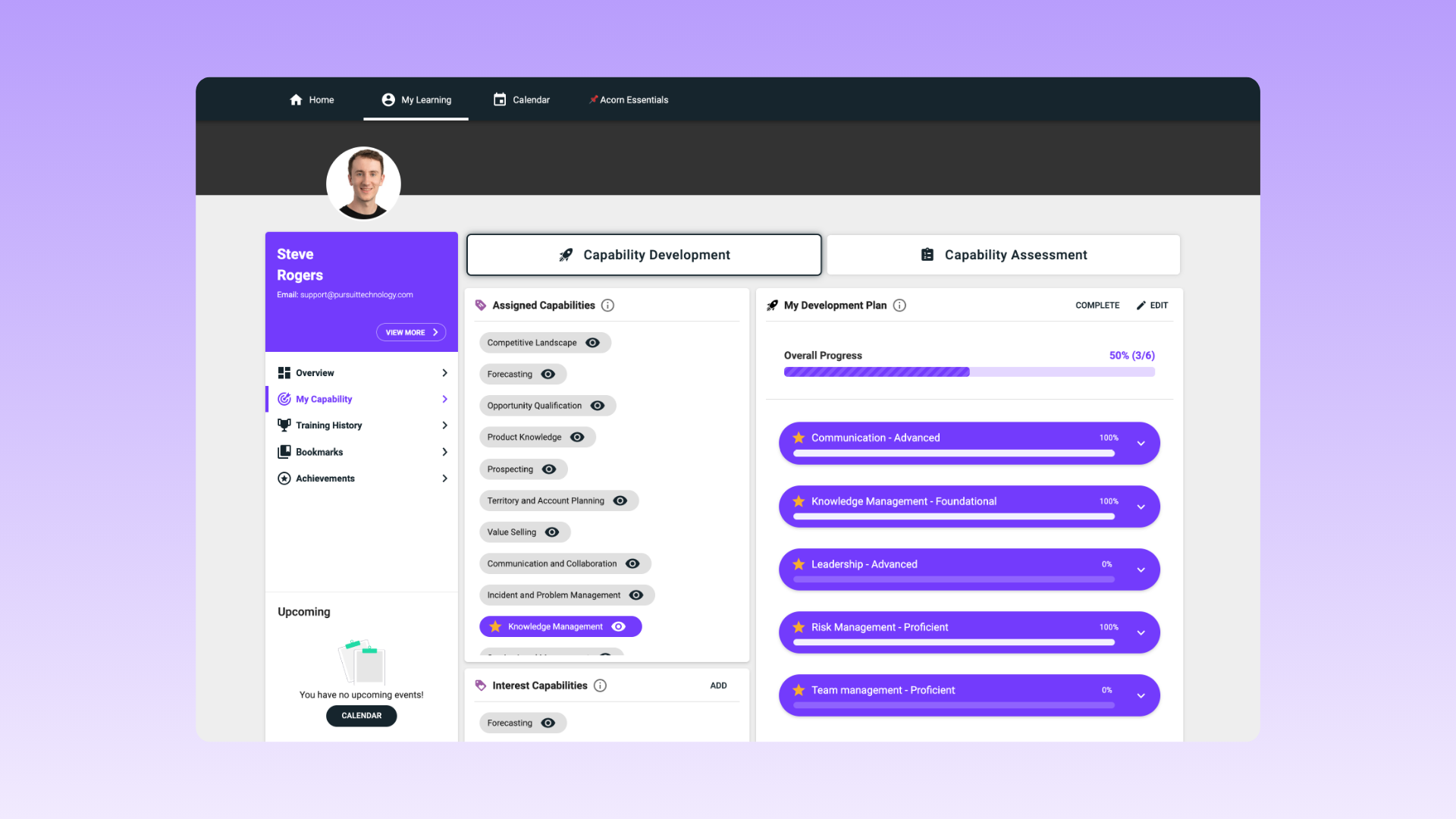
Capabilities gives you that view: what every role requires, at what level, and where each person stands against it. See what it covers.
Frequently asked questions
What is a development plan?
A development plan is a written plan outlining what someone wants to improve on, and how they’ll do it.A professional development plan is the version a person writes for themselves, anchored to what their role and their field require of them over the next six to twelve months. The neighbouring terms differ by owner and horizon: an individual development plan works on the role someone holds today, and a career development plan looks years ahead.
Is a professional development plan the same as a performance improvement plan?
No. A professional development plan is voluntary and forward-looking, and it carries no consequence if a goal changes along the way. A performance improvement plan is a formal step in a performance process, triggered by a shortfall against role expectations, usually running 30 to 90 days, with employment consequences attached. Run them on separate forms, or people will write cautiously on both.
How often should a professional development plan be reviewed?
Every six to eight weeks, attached to a conversation that already exists, such as a 1-on-1. Quarterly is the outside limit before a professional development plan starts to feel like an HR obligation. Each review is a reassessment against the level in the plan, and what comes back decides the next one: a closed gap means a new goal, and an open one means the activities need to change.
How do you know if a professional development plan is working?
Reassess the person against the level the plan was written from, and look at what success looks like for each activity. A professional development plan that’s working produces things you can point at: work they led, a capability assessment that moved, feedback from someone who watched them do it. Completion records and hours won’t answer the question, because they measure what was consumed not what changed.
Should a professional development plan be AI-generated?
AI can draft a professional development plan, and drafting was never the hard part. What a model can’t know is what your role requires at the level you’re aiming at, or where you stand against it today, or what your company’s specific goals are. Those come from a role description and assessment. That’s where we point AI at Acorn: it generates the capability descriptions and proficiency levels a professional development plan gets written against. Get a taste on any role with our free Capability Assistant.