How to Build an Employee Development Plan (With Template)
Reading Time:
Lead the pack with the latest in strategic L&D every month— straight to your inbox.
SubscribeIt’s time we admit most employee development plans are a wishlist.
Someone scribbles three courses in a one-on-one, everyone nods, and the document goes into a drive nobody opens again. A year later, you can say how many courses got completed and almost nothing about whether the person actually got better at their job. That’s not a development plan. That’s a to-do list with good intentions.
It’s a common problem, and an expensive one. Gallup found that one in four U.S. employees say they lack the opportunity to advance, and SHRM found a shortage of career development is consistently one of the top reasons people leave. A plan that’s busy but unmeasurable does nothing to change either.
We’ll cover what an employee development plan actually is, why so many fail, a six-step way to build one, a template you can copy, and a worked example. The throughline is simple: a plan works when it’s built against what the role requires, and you can prove progress.
TL;DR
- An employee development plan is a structured plan that maps where a person is against the skills their role requires, with the goals, actions, and timeline to close the gap.
- Most development plans fail because they list courses instead of targeting the proficiency a role actually needs, so no one can tell if they worked.
- A good plan is built against role requirements and tracks progress against them, not against how many activities got completed.
- The core build is six steps: define role requirements, baseline the person, set goals, choose actions, set a timeline, and review.
- An individual development plan (IDP), professional development plan, and personal development plan are variations of the same instrument, differing mainly in who drives it and the time horizon.
What is an employee development plan?
An employee development plan is a structured plan that maps an employee’s current skills against the skills their role requires, then sets the goals, actions, and timeline to close the gap. Done well, it connects everyday development to what the business actually needs people to be able to do.
Two quick distinctions keep it from blurring into other documents. A development plan isn’t a performance review: a review looks backward at what happened, a development plan looks forward at what someone’s building toward. And it isn’t a training list: a training list is a catalog of activities, a development plan is targeted at specific gaps in a specific role.
Employee, individual (IDP), professional, personal: what’s the difference?
These terms get used interchangeably, which is mostly fine, but here’s the clean version so you can talk about them precisely:
- Employee development plan/individual development plan (IDP): The same thing in practice. An individual-level plan, usually owned with the organization, tied to the requirements of the person’s current role.
- Professional development plan: Often more employee-driven and career-oriented, focused on growing in a profession rather than just a role.
- Personal development plan: Employee-owned, and can stretch beyond work goals entirely.
- Career development plan: The longest horizon, mapping a path across multiple roles over time.
For the rest of this guide, “employee development plan” and “IDP” mean the same instrument. (If you’re specifically building one for managers and senior staff, we’ve got a dedicated guide on the leadership development plan.)
Why most employee development plans fail
The thing is, the point of failure is almost always the same across orgs: a plan is a list of activities disconnected from what the role requires and impossible to measure.
In Acorn’s 2026 State of Learning for AI Fluency Report, 58% of organizations described their development plans as less than effective at building skills, and 61% said they struggle to connect learning activity to a measurable improvement in the work. So, why are we still running them like this?
Often the plan barely exists. It’s a box ticked in an annual review, or a manager telling someone to go pick a few courses. Half of organizations say two-way development conversations happen quarterly or less, so for a lot of people there isn’t much planning going on at all. And when there is a plan, it’s frequently just access to the course catalog: here’s the library, choose what looks useful. And when there is a plan, it’s frequently just access to the course catalog: choose what looks useful.
Because none of it is tied to a target the role requires, no one can say what good looks like, and since completion is the only thing the system counts, a finished course ends up standing in for a developed skill that may not have developed at all.
There’s a second reason, too. Roles don’t sit still, especially now that AI is reshaping what many jobs involve day to day. A plan written once and filed away is aimed at a target that’s already moving. If the plan isn’t tied to current role requirements and revisited, it ages out fast.
To be fair, a simple goals-and-actions plan might be all you need for short-term development. But the moment you need to show whether development is actually happening, a wishlist can’t answer the question.
How to create an employee development plan in 5 steps
Rather than open a spreadsheet and ask what people want to work on, the most effective development plans start at the role.
- Define what the role requires. Get clear on the target: what good performance in this role looks like, based on what the business needs, written as the capabilities and the proficiency level expected for each one. Setting those levels now gives you a clear standard to develop people toward and to measure against, instead of guessing.
- Baseline the person. Run a capability assessment against that framework to see where the employee sits today. The distance between where they are and the level the role needs is the capability gap, and closing it is what the plan is for. Treat self-rating as one input, then add a manager’s view and, where you can, evidence of real work, so the baseline reflects what someone can genuinely do.
- Set goals against the gap. Turn every gap into a SMART goal tied to a target proficiency level. “Improve communication” is too vague to plan or measure; “reach proficient at running a renewal conversation unassisted by Q3” gives you something concrete to develop toward and check against.
- Choose actions across 70-20-10. Development isn’t all courses. Roughly 70% happens on the job, 20% through coaching and others, and 10% through formal training. Map actions to each goal across all three, a stretch assignment here, a mentor there, a course where it genuinely helps, so every activity ladders up to a capability you’re building rather than sitting in a catalog to browse.
- Review and re-base. Track progress against the target proficiency levels on a regular cadence (try quarterly), rather than once a year. Capability builds gradually, so treat the plan as a living document that managers and their teams revisit as people progress.
If defining the skills and proficiency levels for a role feels like staring at a blank page, you can generate a starter framework for any role in about a minute with our Capability Assistant, then build the plan against it. It’s free, and it means you’re starting from real requirements instead of guesswork.
An employee development plan template
A good template keeps the plan specific and measurable, and the columns matter more than the formatting. Here’s the structure:
Notice what’s doing the work here. Every row has a target tied to the role and a way to tell whether the person actually reached it, which is what lets you report on real capability growth rather than activity.
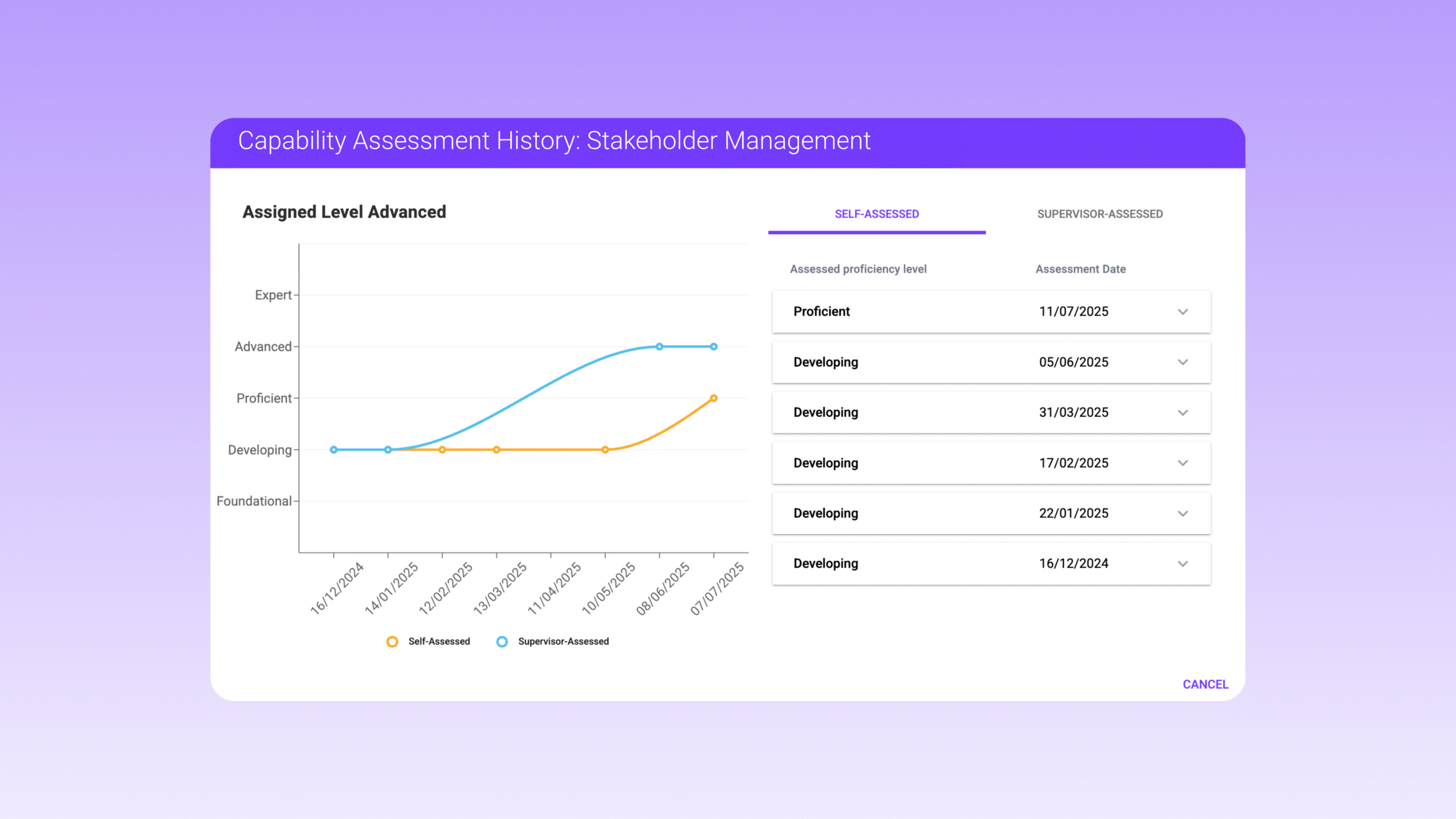
This is exactly what a capability development plan does inside Capabilities: you map each role to the capabilities and levels it requires, assess where a person actually stands, and track the uplift over time. It’s the same instrument as the template above, built on role requirements and measured by capability growth rather than course completions. And because the learning connects back to the gap, a completion finally means something you can see, which is the job Acorn’s internal LMS is built for. None of this replaces what you’ve already got: it works alongside your existing HRIS and LMS through a shared capability framework, as a layer rather than a rip-and-replace.
How to make the plan actually work (and measure it)
A plan only works if you keep it alive. That comes down to two things: how often you check in, and what you actually measure when you do. Three habits make the difference.
- Check in monthly, not once a year. Capability builds in the flow of work, so the conversations should happen there too. Set a short, recurring 1:1 to review one or two priority capabilities, agree on the next piece of learning or stretch work, and capture what’s changed since last time.
- Measure proficiency, not activity. Track where someone sits against the target proficiency level for their role, not how many courses they’ve ticked off. Activity counts are the trap we started with, so if your assessments only show what’s been completed, you’re measuring effort, not capability.
- Back the assessment with evidence. A self-assessment on its own is a guess. Combine it with a manager view or subject matter expert input, and tie each assessment to something the person has actually produced or done. That way you’re recording demonstrated capability, not optimism.
Do this consistently, and you get more than a tidier plan. Development that’s tied to what each role requires, and tracked by real capability growth, is what links an individual’s progress to how they actually perform.
Key takeaways
Done well, an employee development plan maps a person against the capabilities their role requires, closes that gap, and stays useful because you keep it current as the role changes.
- Build it in five steps: define the role’s capabilities, assess the person, set goals against each gap, choose actions across 70-20-10, and reassess continuously.
- Use a template with target-level and evidence columns, the two things generic templates skip.
- Make it measurable by tracking progress against target proficiency, backed by evidence rather than completions.
If you want development plans that track real capability growth rather than activity, Capabilities lets you map each role to the skills it needs, assess where people stand, and build plans that show whether the gap is actually closing.
FAQs
How do you create an employee development plan?
You create an employee development plan by defining the capabilities the role requires, assessing the person against them, turning each capability gap into a SMART goal, choosing development actions across on-the-job, social, and formal learning, then reviewing progress on a regular cadence. The key is building the plan on what the role actually requires and tracking progress against it, rather than listing courses to complete.
Who is responsible for an employee development plan?
Responsibility for an employee development plan is shared. The employee owns their own growth and brings the goals they care about, the manager helps set the targets against what the role requires and supports the day-to-day development, and L&D or HR provides the capability framework and keeps the plan tracked. Plans tend to stall when everyone assumes someone else owns them, so it’s worth naming who’s accountable for each part up front.
How often should you update an employee development plan?
More often than once a year. Quarterly check-ins keep an employee development plan tied to current role requirements and let you adjust goals before they go stale, and you should re-base it whenever the role or business priorities shift. A plan that’s only revisited at annual review time has usually drifted from what the person actually needs.