Executives Think Your Performance System Is Working. Your Employees Don’t.
Reading Time:
Lead the pack with the latest in strategic L&D every month— straight to your inbox.
SubscribeResearch from Acorn’s 2025 Corporate Performance and Learning Survey reveals a wide perception gap in performance management.
Two-thirds of executives say their performance metrics are fair and accurate. Less than one-fifth of individual contributors agree. That’s not a difference of opinion. It’s a different reality.
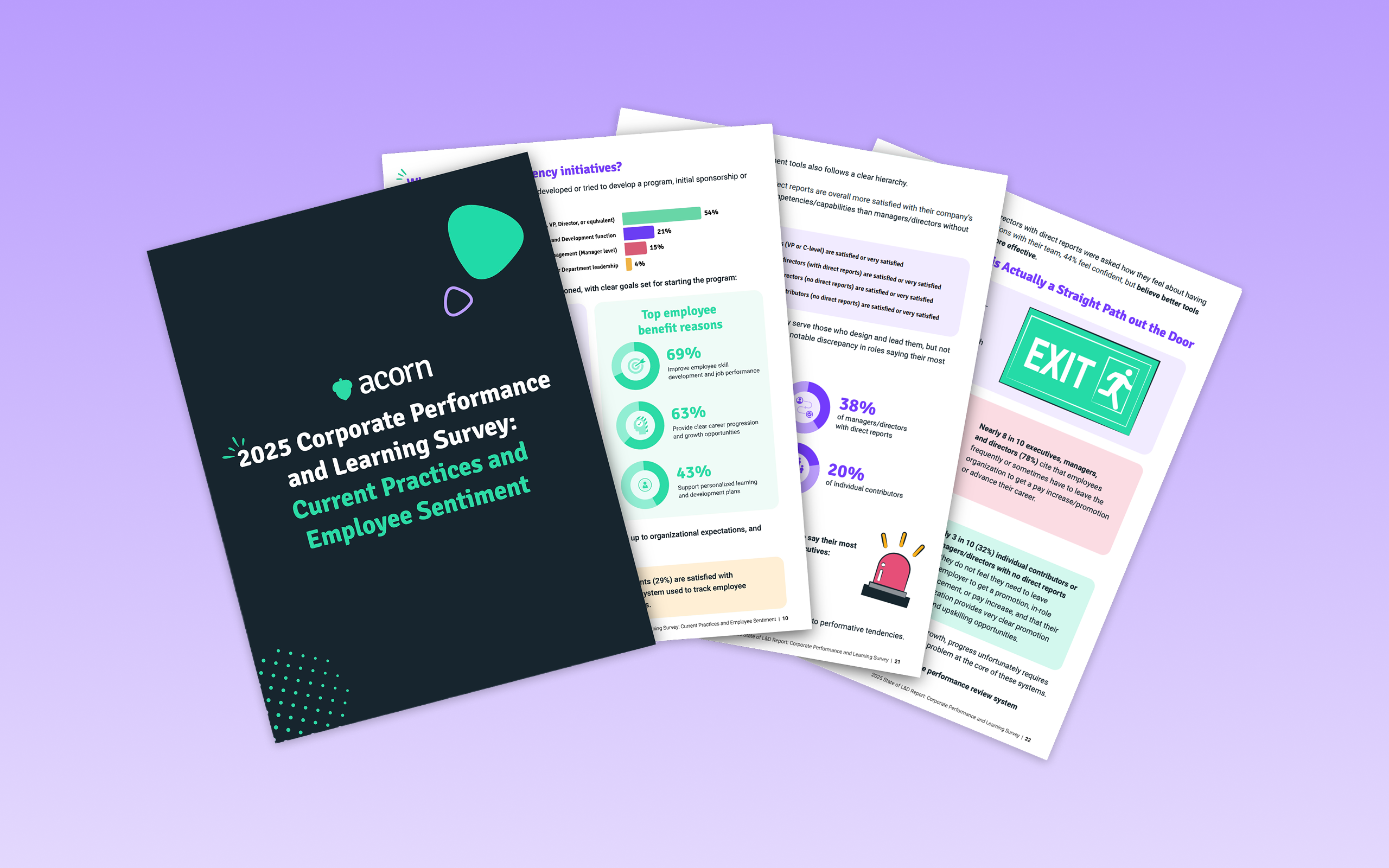
Acorn’s 2025 Corporate Performance and Learning Survey, which gathered responses from more than 1,200 U.S.-based workers across large organizations, shows exactly what it’s costing.
What is the executive perception gap in performance management?
The executive perception gap in performance management is the difference between how senior leaders assess the fairness and effectiveness of their performance systems and how employees at every other level actually experience them.
In Acorn’s 2025 research, that gap is 47 percentage points: 66% of executives say their metrics accurately and fairly reflect employee capabilities, where only 19% of individual contributors agree.
Confidence in the system follows the same hierarchy.
- 65% of executives feel “very confident” their organization has a well-defined capability-tracking system in place
- In comparison, just 36% of managers with direct reports, 23% of managers without, and 19% of individual contributors agree.
- Satisfaction tracks identically, from 86% of executives down to 49% of individual contributors.
Most executives have had positive review experiences personally, tend to have performance conversations framed around strategic outcomes, and are close enough to the investment decisions to assume the programs are working. The survey captures the result: 62% of executives describe their most recent review as collaborative. Only 20% of individual contributors say the same.
The major retention consequence
The executive perception gap has a direct retention cost: when employees can’t see a clear path to advance internally, they leave.
Nearly 8 in 10 executives, managers, and directors acknowledge that employees frequently or sometimes have to leave the organization to get a promotion, pay increase, or career advancement. Turnover is the dominant experience across the teams we surveyed. Deloitte’s research backs this up: they found more than half of employees say it’s easier to find a new role outside their organization than inside it.
Yet, somehow, those leaders rate their performance systems highly.
The dissonance between high confidence in the system and acknowledgment that employees must leave to advance is the clearest evidence of the gap in action. We’ve internalized this as an organizational fact of life, rather than a symptom that something is broken.
From the employee side, the picture is even bleaker. Only 32% of individual contributors and managers without direct reports say they don’t feel they need to leave their employer to advance or get a pay increase. Fewer than half of all respondents say their performance review gives them a clear path to improve and advance in their role.
When organizations can’t answer the question “what do I need to do to grow here?”, employees go somewhere else that can—and take their institutional knowledge with them. (P.S. Gartner’s research on career development and attrition finds that lack of career development is consistently one of the top reasons employees leave—and that fewer than half of employees feel satisfied with the career development their current organization provides.)
The organizational and technological barriers leaders still aren’t seeing
The barriers that sink capability programs—poor system integration, no centralized tracking, competing priorities—tend to be invisible to the executives who approved them. (We know, it’s shocking.)
Among the 69% of organizations that have developed or attempted a competency or capability program, the barriers to making those programs stick are significant and largely invisible to those higher up.
We found most respondents are facing three kinds of technology barriers.
- 48% cite lack of integration with performance management, learning, or talent systems
- 35% say it’s impossible to assess employee capabilities consistently with available technology
- 33% had no centralized system to manage capabilities or track competencies.
And then on the organizational side:
- 42% had no clear process for applying capabilities in day-to-day work
- 52% say competing priorities take precedence
- 46% experienced limited employee adoption or engagement.
And the thing is, employees haven’t given up on performance management because of this. They’re not leaving because they don’t want development: 95% say it’s important or very important to have a two-way dialogue about performance and capabilities. 92% would prefer a composite view of proficiency across role requirements over an arbitrary number ranking. Oh, and 97% believe a simplified, centralized system for tracking capabilities would positively impact their organization.
We’ve developed something just for this. Book a demo to see how Acorn maps capabilities to job roles, so people can see where they stand, where they can improve, and where they can go next.
The bottom line
The executive perception gap isn’t a culture problem. It’s a structural one, with measurable consequences for retention, development, and organizational trust.
Here’s what the data tells us:
- 43% of launched capability programs are never fully integrated into day-to-day operations, and employees know it: 97% say a simplified, centralized system would positively impact their organization.
- 66% of executives believe their performance metrics fairly reflect employee capabilities. Only 19% of individual contributors agree.
- 78% of executives and managers acknowledge employees frequently or sometimes must leave to advance, even as most rate their own systems positively.
Read the full findings from our free report via the link below.
FAQs
Why do capability programs fail to stick?
The most common barriers are structural. Among organizations that have tried, 48% cite a lack of integration with existing HR and learning systems, 35% couldn’t measure capabilities consistently with available technology, and 42% had no clear process for applying capabilities in day-to-day work. Most programs are launched without the infrastructure to sustain them.
Is there a better way to do performance management?
Not to abolish reviews entirely; 95% of respondents say two-way dialogue about performance and capabilities is important or very important. The key is to frame performance conversations around how someone is currently performing, what they need to work on, and what opportunities are available to them next, and you can do that with a capability-led approach.
What’s the difference between a capability-based rating and a traditional performance score?
A traditional performance score is typically a single rating assigned by a manager, often based on subjective impression or relative ranking against peers. A capability-based rating measures proficiency across the specific capabilities a role actually requires, anchoring assessment to observable behaviors rather than manager judgment (which can actually be stressful for managers). Acorn’s 2025 research found that 92% of respondents believe a capability-based approach would be more effective than an arbitrary score.