How We’re Building AI Fluency at Acorn (and Actually Measuring It)

Eloise Littlejohns
Director of Operations & People
Reading Time:
Lead the pack with the latest in strategic L&D every month— straight to your inbox.
SubscribeAI fluency is the phrase everyone’s talking about.
In the last few months, we’ve watched Canva, Atlassian, and Zapier launch their own AI capability frameworks, all built to answer one question: how AI-fluent is your workforce, and how are you measuring it?
Most companies can tell you adoption is up and some kind of AI training has been done, but still aren’t able to determine who can genuinely apply AI to their actual job, at what level, and whether they’re improving.
Measuring capability is what we do, so we measured our own AI fluency the same way we’d help a customer measure theirs.
Here’s how we’re doing it, in four steps, and what the data has told us so far.
1. We defined what AI fluency actually means
AI fluency is the demonstrated ability to apply AI tools to produce quality, role-appropriate work, not a course you complete once. You can’t measure something you haven’t defined, so before anything else we wrote out what that means at Acorn in plain language: a simple AI capability set, with a description of what foundational, developing, proficient, and advanced look like.
We kept it deliberately simple. The temptation with anything AI-related is to over-engineer the definition until it’s so detailed nobody uses it. It also plugged into how we already work, where we define the handful of capabilities each role needs and the proficiency level expected for each. The AI capability set just became another layer on top of that, so we weren’t adding a parallel process to people’s to-do lists.
2. We set standards across every role
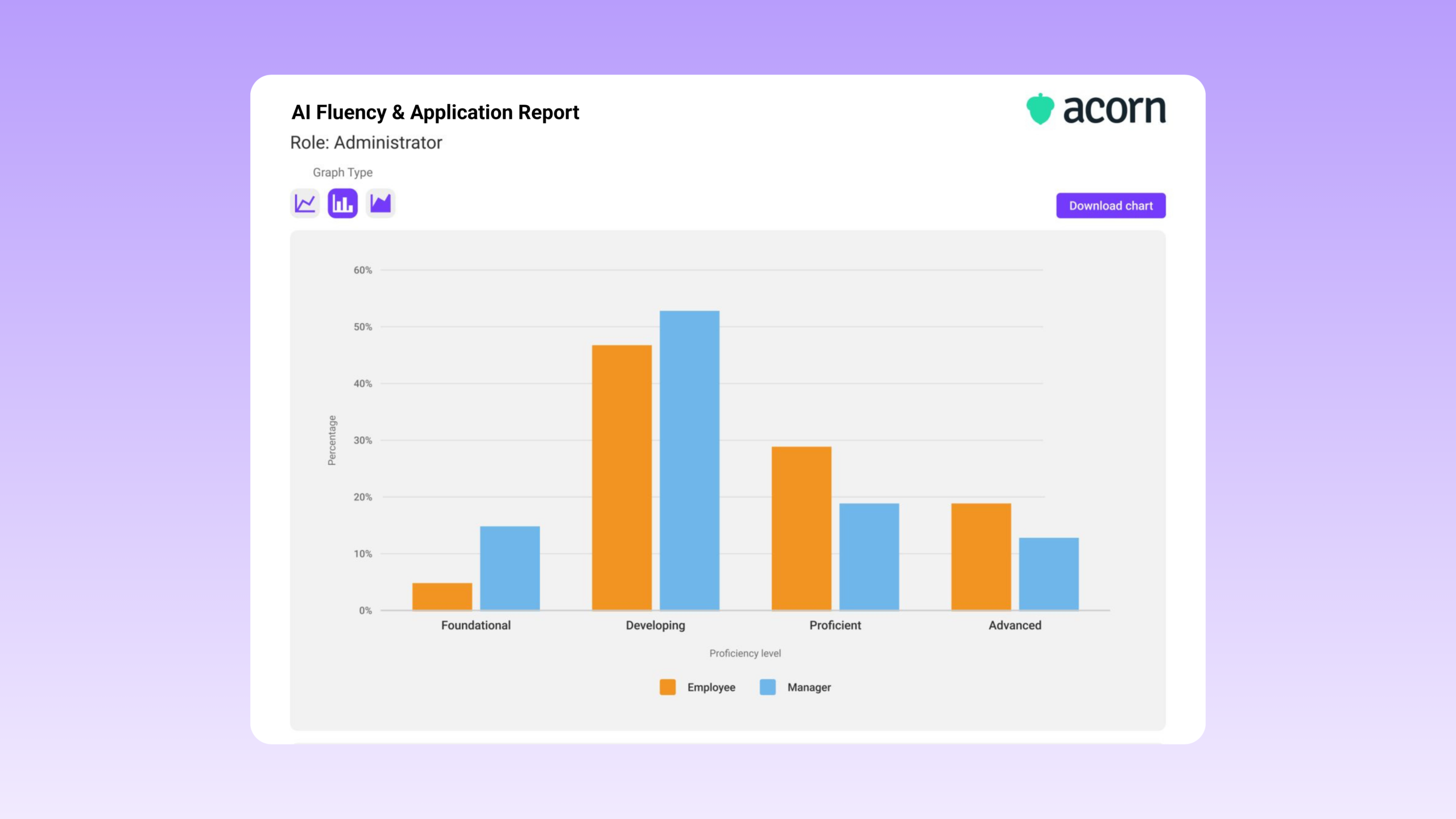
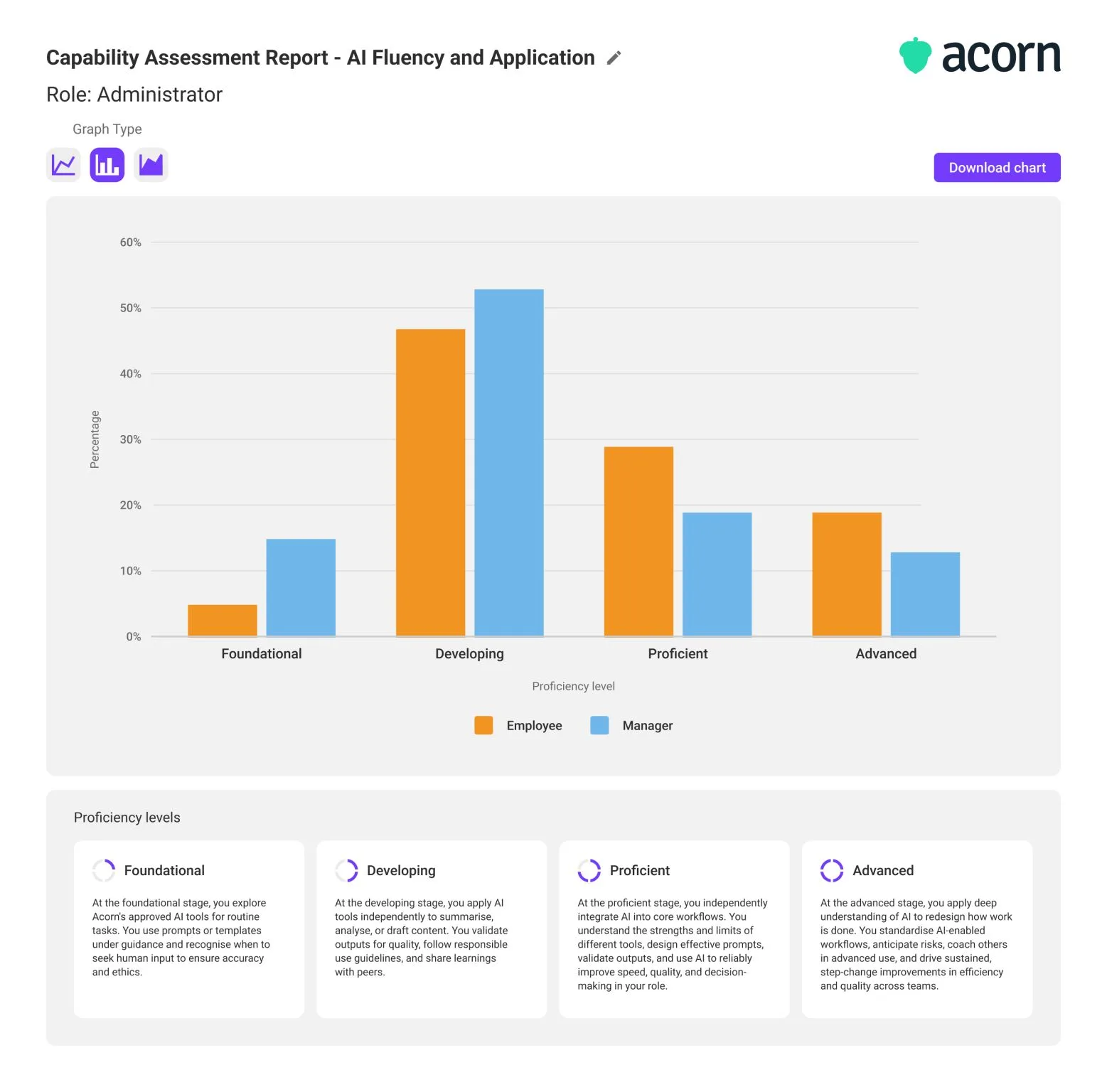
You measure it from two sides. Every Acornian assesses their own AI fluency on our platform, then their manager reviewed and validated each rating. Two signals, not one.
Here’s the latest checkpoint:
| AI fluency level | Share of the team |
|---|---|
| Foundational or developing |
52%
|
| Proficient |
29%
|
| Advanced |
19%
|
The best bit wasn’t that split. It was that the self-assessments and the manager-validated assessments didn’t fully match. People assessed themselves differently from how their managers saw them, in both directions, and that disparity turned out to be the single most useful thing we learned. It’s exactly the conversation that moves someone forward: where do you think you are, where do I think you are, and what would close the gap? Self-assessment alone leans on confidence over output. Manager assessment alone misses what people are quietly doing with AI that their manager never sees. Together they give you something you can actually act on.
At the click of a button, I can now see where the whole workforce sits on AI fluency and, more usefully, watch it move over time.
See where your own workforce stands.
Take a look at how Capabilities works today.
3. We turned the gaps into a development engine
A number on its own changes nothing. The checkpoint told us where the gaps were, and the next job was closing them, but we were clear the answer wasn’t a polished course. Hands-on time with the tools beats waiting for formal training that’s out of date the week it ships. The blockers are just that most people don’t know where to start, and they don’t carve out the time.
So, we built Prompt Wizards: a series of 30-minute drop-in sessions focused on a specific tool or workflow, supported by a dedicated Microsoft Teams channel where our team members can share the cool things that they’re trying, building and get help if they’re getting stuck. People drop in, get a practical walkthrough, and share how they’re using AI in their own role. A few of the sessions:
- Build Claude Projects from scratch
- Claude CoWork, treating AI as a colleague rather than a search box
- Build Lab, automating real workflows with Acorn Momentum
- Claude Skills: build once, use forever
Two deliberate choices made the difference. The sessions are peer-led and pitched at different proficiency levels, so we meet people where they are. And we record everything into an ongoing AI fluency learning journey, backed by a channel for resources, tips, and showing off what people have built (something that’s being developed into our platform, too).
When Atlassian looked at what set their strongest AI users apart, it wasn’t tool mastery, it was the habit of teaching others what they’d worked out. Peer-led sessions are how you grow more of those people. The clearest signal it landed: within one week of Claude Design launching internally, 50% of the workforce had been trained and were using it.
4. We made it a quarterly habit, not a one-off
We run AI fluency checkpoints on the same cadence as the rest of our capability checkpoints, with a review from both the employee and the manager. The mistake I was determined not to make was treating this as a one-time audit. One checkpoint is a snapshot. What you actually want is the trend line. The conversation that matters isn’t the assessment itself. It’s sitting down to see where expectations and reality have drifted, then talking about what changes before next quarter.
Building in public, on purpose
None of this took a big framework or a research budget. It took a clear definition, two honest signals, and the willingness to look at the gap between them. That’s within reach for any People team, and it’s the difference between guessing at the AI fluency question and actually answering it. I’d love to hear how other People leaders are tackling it.
If you want the full picture of where AI fluency stands across organizations, including the data behind the activity-versus-evidence gap, download our 2026 State of Learning for AI Fluency report. And if you want to run this on your own workforce the way we did, take a guided tour of Capabilities.